After 63 years since its establishment on the basis of international cooperation, ESO is now de facto evolving "from world-class to world-leading", in light of the huge progress within its strategy for the 2020s. Let me share with you some achievements and challenges that developed during 2025.
First and most important, the scientific data delivered by ESO’s facilities generated many breakthroughs. I would not be surprised if the record number of refereed science publications in 2024 (1207) would be exceeded in 2025. Personally, I was blown away by the ALMA observations of the most distant galaxy (at z=14) found by JWST, which revealed a high Oxygen abundance at this very early galaxy as well as its dynamical mass (Carniani et al, 2025, A&A, 696, A87; Schouws et al, 2025, ApJ, 998, 19). Likewise the finding of a Jupiter-sized planet around star HD 135344B using VLT/ERIS (Maio et al 2025, A&A, 699, L10), showing direct evidence of a planet being formed in a protoplanetary disk.
ELT construction and instrumentation - Outstanding progress & challenges
The ELT telescope continued making steady progress and heading towards the very challenging AIV phase. A risk analysis has led to schedule delays: first telescope light in March 2029 and first science observations in December 2030. The Cost to Complete (CtC - including both telescope and construction instruments) had to be increased by almost 90 MEUR. For the instruments, increased costs are associated to enhanced technical support from ESO, and to contingency. While ESO will absorb the additional ELT construction CtC into its long-term financial projections, it will be at the expense of a very tight budgetary situation over the next years.
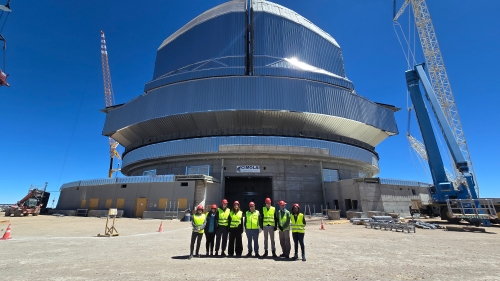
However, progress has been huge. The mechanical structure of the Dome and Main Structure (DMS) is nearing completion, the dome is almost fully cladded, the sliding doors are installed and close smoothly and HVAC systems are being installed. At the top of Cerro Armazones, looking at the ELT from outside and inside is overwhelming.
More than 200 ELT M1 fully processed and coated segment assemblies are in their boxes at the ELT Technical Facility (ETF) ready to go to the telescope, with the production chain at full throttle. The 4-m concave M2 mirror is fully tested with its cell and will go to Paranal early 2026. The most technically challenging element of the ELT, the M5 SiC CVD coated mirror, is progressing very well on its polishing. The two Pre-Focal Stations are on factory tests, the Phasing and Diagnostic Station is being integrated at ESO, and control and supporting systems are also progressing very well.
MICADO and METIS continue moving forward through the Manufacturing, Assembly, Integration and Test (MAIT) phase, while MORFEO is heading towards Final Design Review (FDR) in 2026. A rescoped concept of HARMONI has been worked out by the consortia and ESO together. ESO’s Scientific and Technical Committee welcomed the new version and will provide feedback in April 2026. Both ANDES, and since December 2025 MOSAIC, are on Phase B progressing towards Preliminary Design Review (PDR).
La Silla Paranal - amazing present, defining the future
LPO continued to deliver high-quality scientific data, thanks to the continued effort from Paranal and Garching. The first yearly call for proposals (CfP117) was launched (1300 proposals were received – within expectations), with one of the potential benefits being that yearly scheduling will produce higher completion rates. Distributed Peer Review (DPR) is used to assess half of the proposals, but most of the observing time is granted through traditional panel discussions. There are no strong complaints from the community according to ESO’s user reviews.
First light of 4MOST on VISTA was achieved in October, and first fringes of GRAVITY+ in November – two remarkable milestones of ESO at large and the consortia. MOONS will be installed and commissioned at the VLT in 2026. SoXS at the NTT in La Silla seems to be finding its way forward for the IR channel, which experienced issues. CUBES passed FDR in July, FORSup is heading towards Test Readiness Review in 2026. MAVIS underwent FDR in October, report to be delivered soon.
The Integrated Operations Programme (IOP), aiming at a process-based lean, remote and high-performance operations model for the VLT/VLTI and the ELT, is making progress through its Phase B. Subject to a successful Phase B review in Q3/2026, the IOP will be formally approved and its projects start on a staggered way. The time critical ELT DMS maintenance process project is already well advanced.
Threats to the quality of the Paranal observatory site have become a very fundamental risk for ESO. The INNA project, aiming at installing a huge industrial hydrogen plant in the outskirts of the Paranal territory would cause large increases in light pollution, atmospheric turbulence degrading the image quality, dust during construction and vibrations that would challenge the phasing of the ELT M1 segmented mirror and the VLTI operation (see summary of ESO’s technical report submitted to the citizen participation process of the environmental assessment). The environmental assessment will still take some time, and a decision by the Government of Chile should follow. A letter signed by eminent astronomers addressed to the Government of Chile requests protection to Paranal as the world’s best site for optical astronomy, equipped with the most powerful telescopes.
For La Silla, there is a 10-year future which is defined with HARPS and NIRPS at the 3.6m and with SoXS at the NTT. A discussion with the community, STC and Council needs to take place in the next 1-2 years to decide the scientific future of the site beyond 2035.
ALMA - A critical time to move forward
In Cycle 11 ALMA achieved for the first time almost 4500 hours of observation with the 12 m array (target is 4300 hours). Better planning and substantial decrease of projects that would have taken away science time, are key to this achievement. Science productivity continues to be very high, with the ESO community leading over the other parties.
With a global oversubscription of the order of 8, time allocation requires a lot of attention. DPR has been adopted for all proposals requesting less than 50 hours (85% of the observing time). Discontent in the community on the use of DPR at ALMA is significant, and trust needs to be restored through transparency.
On the ESO side of ALMA development, more than 50% of the Band 2 receivers were delivered, 30 ALMA antennas have already been equipped with the receivers and Science Verification data taken with Band 2 preliminarily shows good performance across Bands 2 and 3. The contract for the fiber link between OSF and AOS was placed, while the WIPF (digitisers) project proved difficult and is nearing PDR. Efforts to contribute to data processing software are being discussed, and so are Band 7 studies.
The Wide-band Sensitivity Upgrade Programme passed a Systems PDR, with significant actions. Work is ongoing to address those and to prepare for the cost review in 2026. WMAC (WSU Management Advisory Committee) advises on the way forward. WSU approval is foreseen in November 2026, subject to a programmatically sound and affordable way forward.
CTAO - taking off
The CTAO ERIC was approved by the European Commission in January, following a long and tortuous process. The new Governance scheme has been established, the basic regulatory documents have been also approved and Dr. Stuart McMuldroch has been formally appointed as the CTAO ERIC Director General. The governance itself is in its infancy, ESO is trying to help by sharing its experience.
Infrastructure work at the CTAO-South side has started, with the roads and telescope foundations. First telescopes in Paranal are expected in late 2026 or 2027. Operational principles and plans are in discussion between ESO and CTAO.
A preliminary update of the cost book shows a substantial increase in the CTAO central costs. CTAO Council has mandated a review, looking at various scenarios. For ESO it is essential that CTAO remains an observatory and not an experiment.
Looking forward - Expanding Horizons
The Expanding Horizons process, aiming at identifying the next ESO Programme, took off during 2025. The focus was, and still is, to identify the scientific challenges of astronomy in the 2040s that could not be addressed with the existing facilities or the ones that will be available by then. This is a “science vision” exercise above all, with the support and oversight of the Expanding Horizon’s Senior Science Committee (SSC).
In the community there appears to be much “future facility” thinking going on, but not so much “future science” consideration. To focus on science first and to understand the landscape of scientific challenges in the 2040s, the SSC launched a call for science White Papers, with a deadline of 15 December 2025. A science workshop, looking also at disruptive technologies, is being organised for Q2/Q3 2026, to put this on the table prior to launch the Call for Ideas for a new transformational facility.
This is my last end-of-year report in the ESO Science Newsletter. I’m privileged to lead this fantastic organisation since September 2017, and I’m equally privileged to hand over the duties to my colleague Andreas Kaufer in September 2026. Thanks to all of you, members of the community that we serve, for your unfailing support.