


BlueMUSE

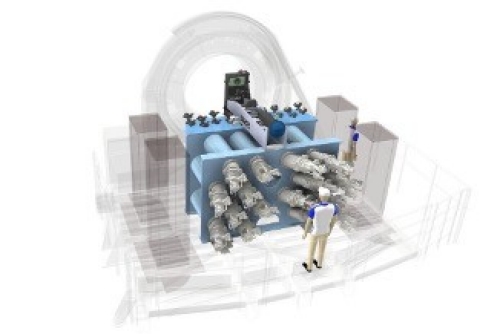
BlueMUSE is an optical seeing-limited, blue-optimised, medium spectral resolution, panoramic integral-field-spectrograph. The project is an evolution of the technology used on the VLT / MUSE instrument, with a similar architecture and technology, but optimized for new science cases.
Baseline Specifications
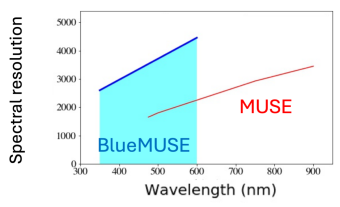
| Spectral Resolution | Average R = 3500, R>2600 over the whole wav. range |
| Wavelength Range | 350-580 nm (330-600 nm in extended wav rage) |
Field of view |
1 arcmin2 |
| Throughput | Average > 25%, > 15 % over the whole wav. range |
| Spatial sampling | 0.2’’ X 0.3’’ spaxels |
| Spectral sampling of the LSF | > 2 spectral pixels |
Scientific Objectives
- BlueMUSE will provide systematic maps of stellar properties and chemical compositions for very massive clusters in the Milky Way and local group galaxies. Since hot stars are intrinsically blue, BlueMUSE’s wavelength coverage aligns closely with the peak of their spectral energy distributions, offering significant advantages over MUSE. Additionally, the larger spectral resolution of BlueMUSE and the larger number of the absorption lines in the BlueMUSE spectral range will enable a more detailed exploration of the stellar properties, their kinematics and the presence of binaries within these environments.
- BlueMUSE will map HII regions, ISM properties and investigate local starburst galaxies to understand the interplay between star formation and feedback under extreme conditions, which are analogous to those of high-redsihft galaxies. Its high throughput will facilitate the census of the start formation and dynamical properties of low-surface-brightness galaxies. BlueMUSE’s spectral resolution will enable kinematic studies of low-mass galaxies, the turbulent gaseous phase, as well as higher order kinematics of unresolved stellar populations.
- BlueMUSE will map the gas flows around and between galaxies, spatially and kinematically. Mapping the circum-galactic medium (CGM) in LyA with BlueMUSE at Cosmic Noon (2 < z < 3) will be key in constraining galaxy formation across the peak of cosmic star formation. This period is essential to probe the predicted changes in the main channel of gas accretion onto galaxies, from cold gas filaments at high redshift to hot-mode accretion at later times. BlueMUSE will also be highly efficient at detecting gas filaments in the intergalactic medium (IGM), as well as discover and characterize giant LyA nebulae around the first generation of forming galaxy clusters (1.8<z<3). BlueMUSE will also be a discovery machine for the gravitationally lensed giant arcs at lower redshifts (z~2) and background lensed sources in the redshift range 2<z<4, filling the current gap.
Instrument Description
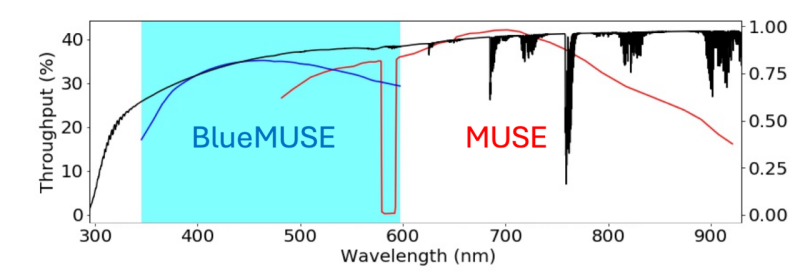
BlueMUSE will cover in one setting the 350-580 nm spectral range at R~3500, expanding the MUSE spectral range (480-930 nm) towards the blue and near-UV at double the spectral resolution. BlueMUSE will achieve exquisite end-to-end throughput (e.g. 35% at 480 nm, 20% at 350 nm), high stability and high efficiency. BlueMUSE will not support adaptive optics and observations will be taken in a single observing mode.
BlueMUSE will use image slicers and consist of fore optics (to reshape the VLT focus), splitting and relay optics which split the FoV into 16 beams and relay the light to the entrance of each IFU. Each IFU consists of an image slicer, a spectrograph, and a vacuum-cooled detector system. The whole system is supported on the Nasmyth platform by a main structure which is surrounded by a passive thermal enclosure to improve instrument stability.
Documents
Richard et al. 2019 contains a broad overview of the BlueMUSE science case.
The consortium website (https://bluemuse.univ-lyon1.fr/) contains further information.