Young or old? — There’s both
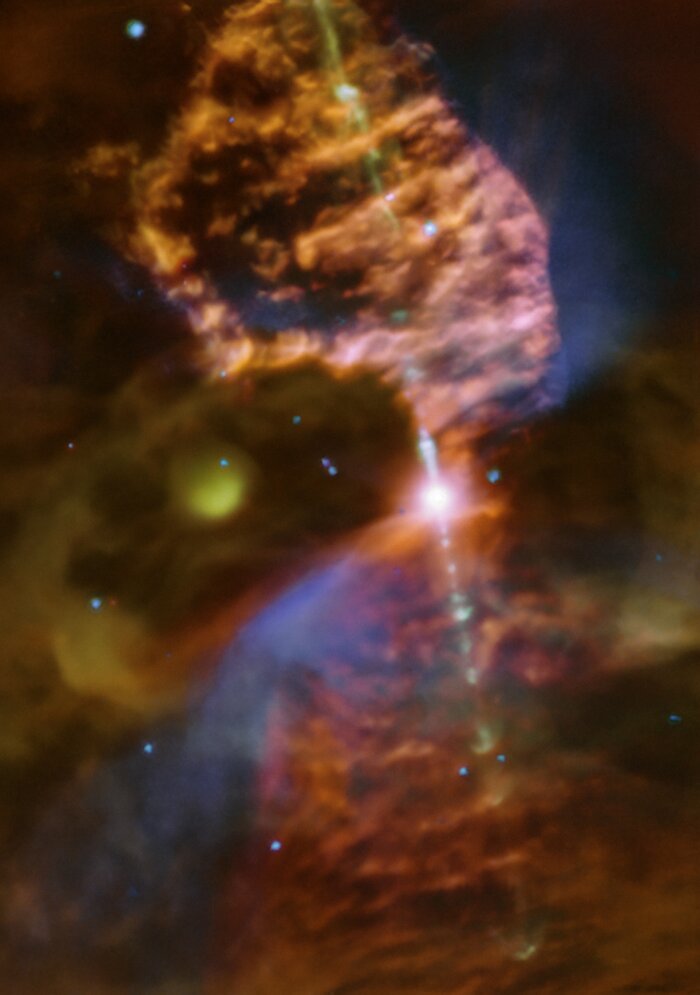
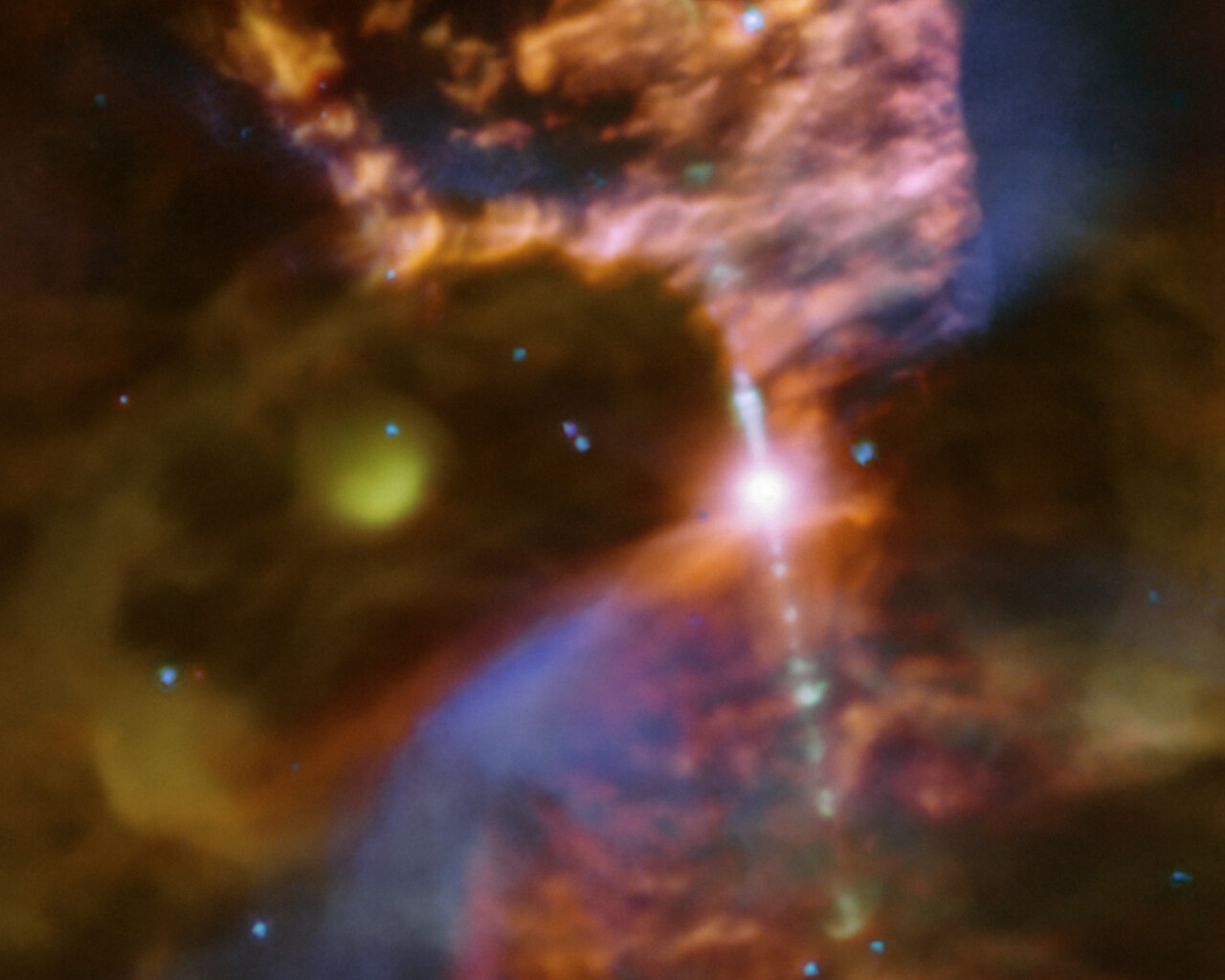
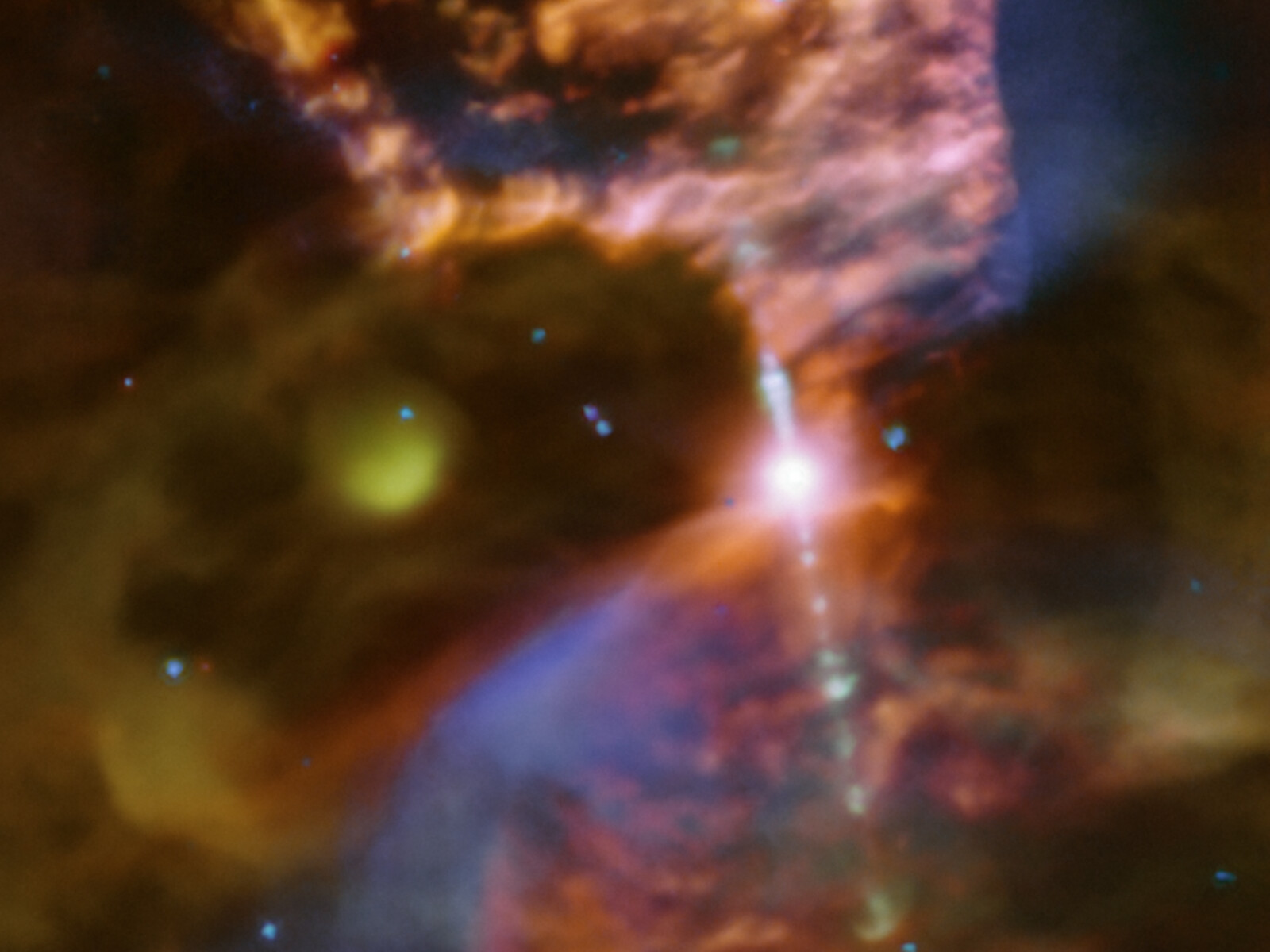
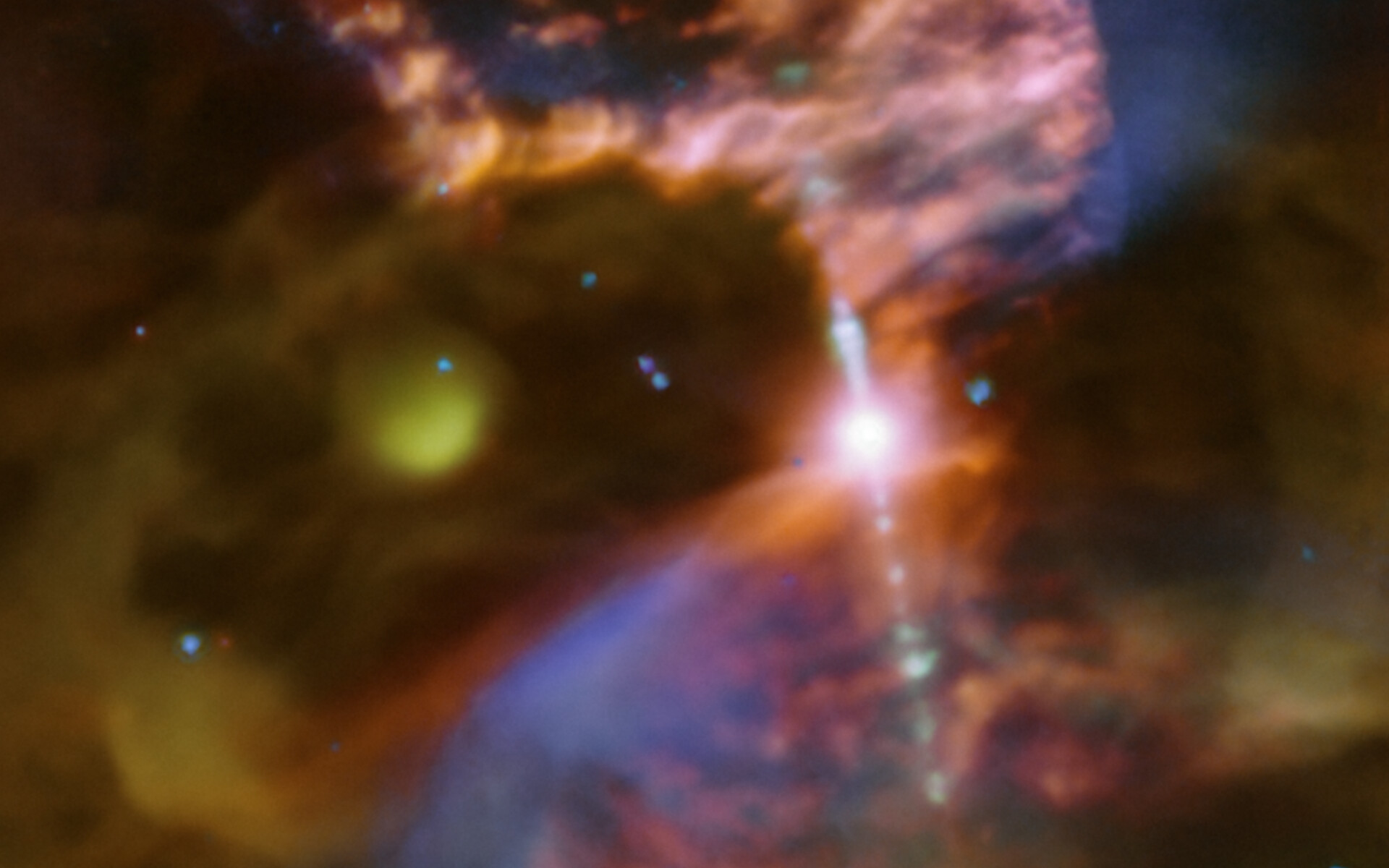
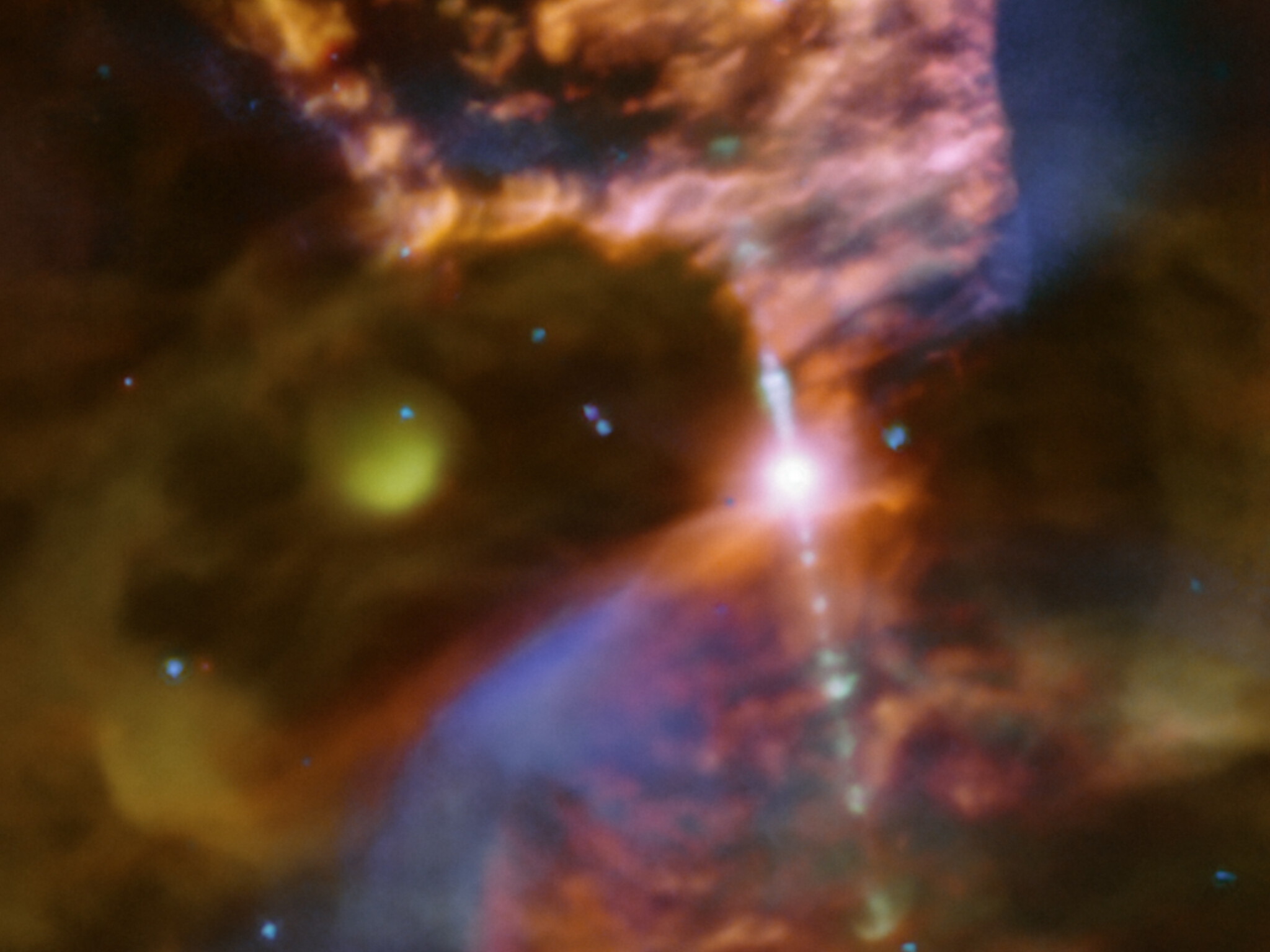
Today’s Picture of the Week represents an unexpected full circle moment. The depicted object, known as Ve 7–27, was long believed to be a planetary nebula — the end phase of a sun-like star’s life. But ESO’s Very Large Telescope (VLT) has shown that it’s actually a still-forming baby star.
For years the true nature of this nebula had been debated, but the VLT’s MUSE instrument has now captured the first detailed image of this object. It shows that Ve 7-27 is shooting energetic jets with knots or ‘bullets’ along them, which is typical for newborn stars. “Instead of being the “last breath” of a dying star, Ve 7-27 is a newborn one,“ says Janette Suherli, a PhD candidate at the University of Manitoba, Canada and first author of the study that revealed this surprising finding.
But there’s an actual dead star lurking just nearby. The compact yellowish-green smudge to the centre-left of this image hosts a neutron star produced when a massive star exploded as a supernova. This nebula is part of a larger cloud ejected by the explosion, the Vela Junior supernova remnant. The MUSE observations revealed that the baby star Ve 7-27 is embedded in the material expelled by this supernova. The distance to Vela Junior had never been precisely constrained before, but now we know this object is close to Ve 7-27. Since Ve 7-27 is known to be about 4500 light-years away, so is Vela Junior. Pinpointing the distance to Vela Junior means we now finally know its size, how fast it is expanding, how energetic it is, and how long ago the supernova exploded, solving decades of inconsistencies. The discovery therefore gives insights to not only the energetic baby star but also the true nature of Vela Junior and represents an “outstanding case of stellar birth and stellar death co-existing side by side in the same environment,” as Suherli describes.
Links
Crédit:ESO/J. Suherli et al.
À propos de l'image
| Identification: | potw2604a |
| Type: | Observation |
| Date de publication: | 26 janvier 2026 15:00 |
| Taille: | 1416 x 2012 px |
À propos de l'objet
| Nom: | Ve 7–27, Vela Junior |
| Type: | Milky Way : Star : Evolutionary Stage : Young Stellar Object Milky Way : Star : Evolutionary Stage : Neutron Star Milky Way : Nebula : Type : Supernova Remnant Milky Way : Nebula : Type : Jet |
| Catégorie: | Nebulae Stars |


Fonds d'écran

Couleurs & filtres
| Domaine | Longueur d'onde | Télescope |
|---|---|---|
| Visible Nickel | 737 nm | Very Large Telescope MUSE |
| Visible Nitrogen | 658 nm | Very Large Telescope MUSE |
| Visible H-alpha | 656 nm | Very Large Telescope MUSE |
Our use of Cookies
We use cookies that are essential for accessing our websites and using our services. We also use cookies to analyse, measure and improve our websites’ performance, to enable content sharing via social media and to display media content hosted on third-party platforms.
ESO Cookies Policy
The European Organisation for Astronomical Research in the Southern Hemisphere (ESO) is the pre-eminent intergovernmental science and technology organisation in astronomy. It carries out an ambitious programme focused on the design, construction and operation of powerful ground-based observing facilities for astronomy.
This Cookies Policy is intended to provide clarity by outlining the cookies used on the ESO public websites, their functions, the options you have for controlling them, and the ways you can contact us for additional details.
What are cookies?
Cookies are small pieces of data stored on your device by websites you visit. They serve various purposes, such as remembering login credentials and preferences and enhance your browsing experience.
Categories of cookies we use
Essential cookies (always active): These cookies are strictly necessary for the proper functioning of our website. Without these cookies, the website cannot operate correctly, and certain services, such as logging in or accessing secure areas, may not be available; because they are essential for the website’s operation, they cannot be disabled.
Functional Cookies: These cookies enhance your browsing experience by enabling additional features and personalization, such as remembering your preferences and settings. While not strictly necessary for the website to function, they improve usability and convenience; these cookies are only placed if you provide your consent.
Analytics cookies: These cookies collect information about how visitors interact with our website, such as which pages are visited most often and how users navigate the site. This data helps us improve website performance, optimize content, and enhance the user experience; these cookies are only placed if you provide your consent. We use the following analytics cookies.
Matomo Cookies:
This website uses Matomo (formerly Piwik), an open source software which enables the statistical analysis of website visits. Matomo uses cookies (text files) which are saved on your computer and which allow us to analyze how you use our website. The website user information generated by the cookies will only be saved on the servers of our IT Department. We use this information to analyze www.eso.org visits and to prepare reports on website activities. These data will not be disclosed to third parties.
On behalf of ESO, Matomo will use this information for the purpose of evaluating your use of the website, compiling reports on website activity and providing other services relating to website activity and internet usage.
Matomo cookies settings:
Additional Third-party cookies on ESO websites: some of our pages display content from external providers, e.g. YouTube.
Such third-party services are outside of ESO control and may, at any time, change their terms of service, use of cookies, etc.
YouTube: Some videos on the ESO website are embedded from ESO’s official YouTube channel. We have enabled YouTube’s privacy-enhanced mode, meaning that no cookies are set unless the user actively clicks on the video to play it. Additionally, in this mode, YouTube does not store any personally identifiable cookie data for embedded video playbacks. For more details, please refer to YouTube’s embedding videos information page.
Cookies can also be classified based on the following elements.
Regarding the domain, there are:
- First-party cookies, set by the website you are currently visiting. They are stored by the same domain that you are browsing and are used to enhance your experience on that site;
- Third-party cookies, set by a domain other than the one you are currently visiting.
As for their duration, cookies can be:
- Browser-session cookies, which are deleted when the user closes the browser;
- Stored cookies, which stay on the user's device for a predetermined period of time.
How to manage cookies
Cookie settings: You can modify your cookie choices for the ESO webpages at any time by clicking on the link Cookie settings at the bottom of any page.
In your browser: If you wish to delete cookies or instruct your browser to delete or block cookies by default, please visit the help pages of your browser:
Please be aware that if you delete or decline cookies, certain functionalities of our website may be not be available and your browsing experience may be affected.
You can set most browsers to prevent any cookies being placed on your device, but you may then have to manually adjust some preferences every time you visit a site/page. And some services and functionalities may not work properly at all (e.g. profile logging-in, shop check out).
Updates to the ESO Cookies Policy
The ESO Cookies Policy may be subject to future updates, which will be made available on this page.
Additional information
For any queries related to cookies, please contact: pdprATesoDOTorg.
As ESO public webpages are managed by our Department of Communication, your questions will be dealt with the support of the said Department.