Persbericht
Dode ster en planetaire hemellichamen: astronomen ontdekken schijf van puin die de toekomst van ons zonnestelsel laat zien.
27 oktober 2026
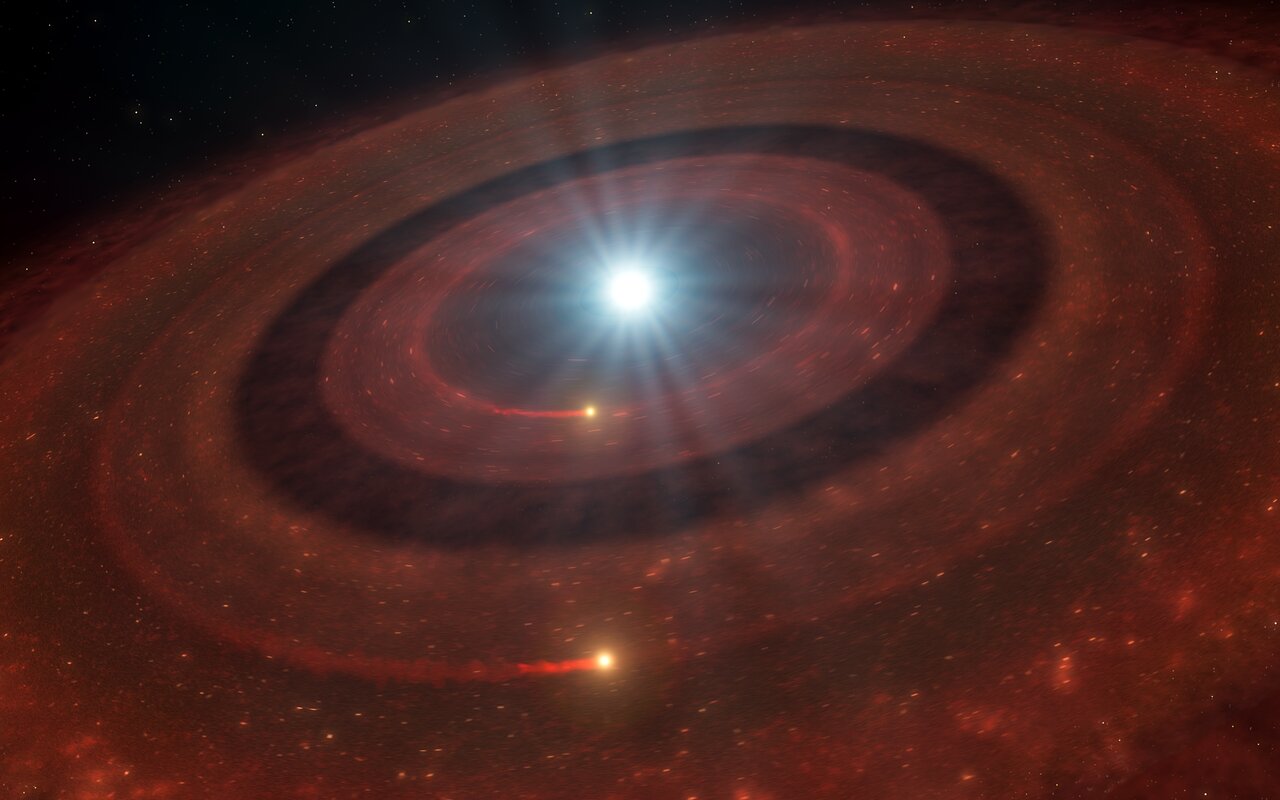
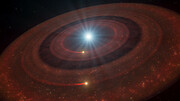
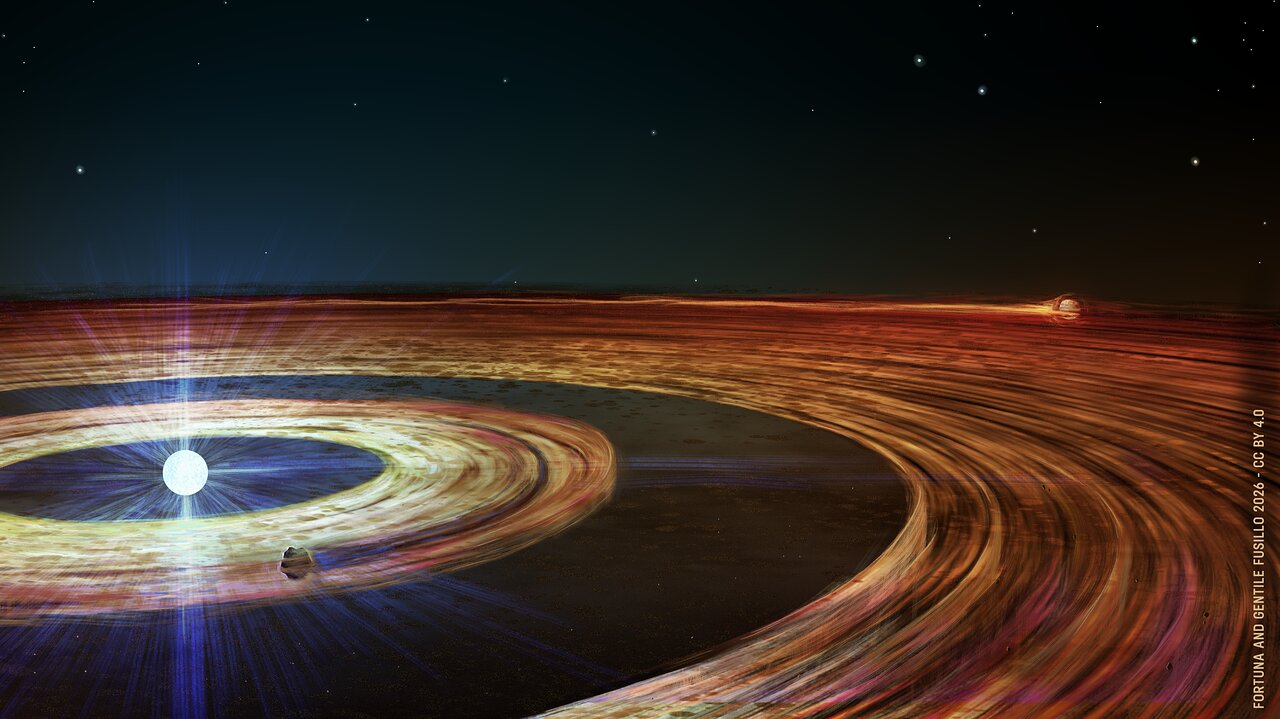
Astronomen hebben, met behulp van de Very Large Telescope (VLT) van de Europese Zuidelijke Sterrenwacht (ESO), een bijzondere schijf van puin rond een dode ster ontdekt, die een impressie geeft van wat er in de verre toekomst met ons zonnestelsel zal gebeuren. Anders dan bij eerder ontdekte voorbeelden is het puin – de overblijfselen van planeten die ooit rond de ster draaiden – verdeeld over twee gordels die duidelijk van elkaar gescheiden zijn. Het lijkt erop dat de schijf het overblijfsel is van twee planetaire hemellichamen – waarvan er één mogelijk zo groot was als Pluto – die de dood van hun moederster hebben doorstaan.
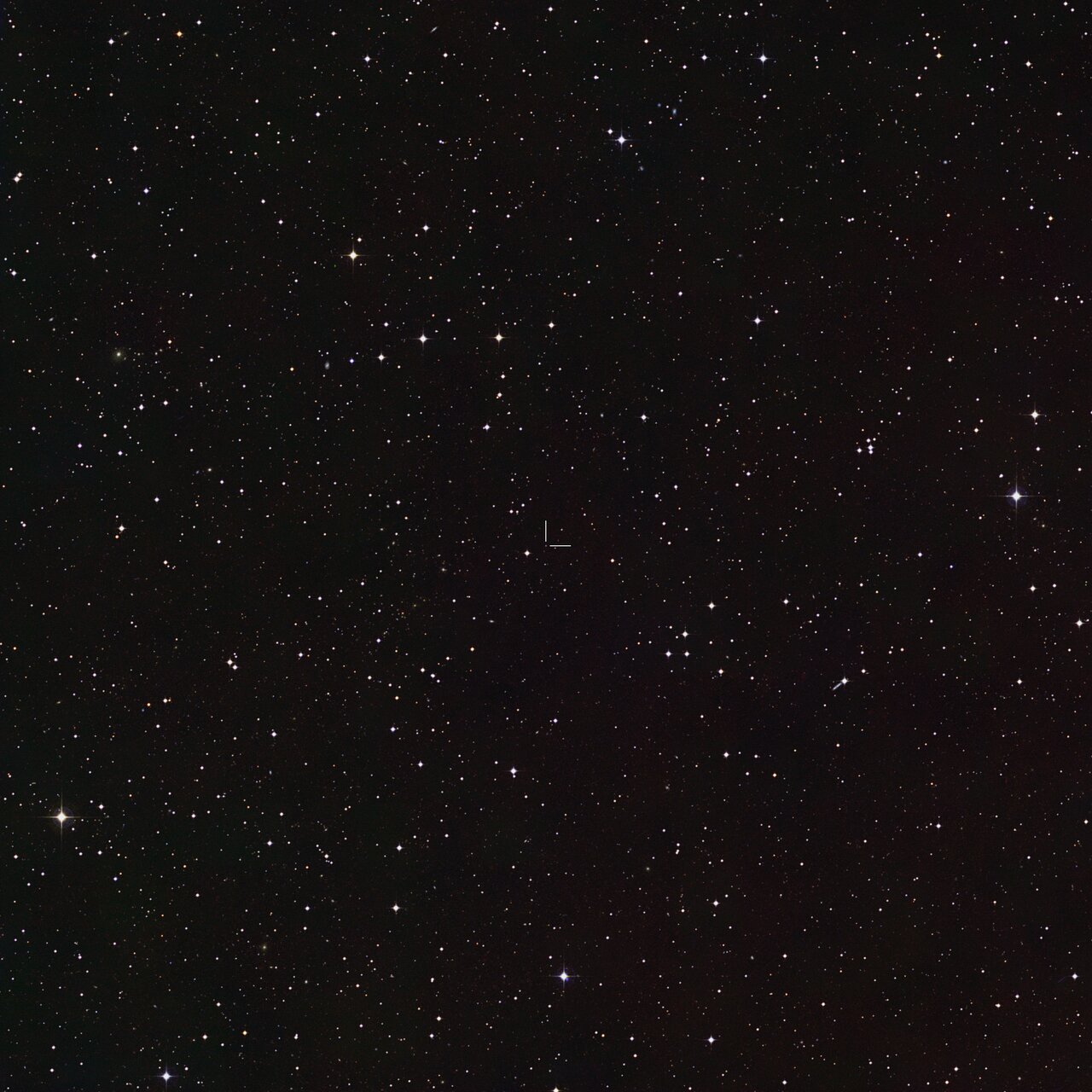
‘We weten al een tijdje dat planeten de transformatie van de ster waar ze omheen draaien kunnen overleven, maar dit is het eerste voorbeeld van een ingewikkeld stelsel met een dubbele puinschijf en mogelijk twee overgebleven planetesimalen’, zegt Nicola Gentille Fusillo, astronoom aan de Università degli Studi di Trieste in Italië en hoofdauteur van de studie die vandaag in Nature Astronomy is gepubliceerd. De centrale ster van dit stelsel is de witte dwerg J1328−1450: de compacte, uitgebrande kern die achterblijft wanneer een zonachtige ster al zijn brandstof heeft verbruikt.
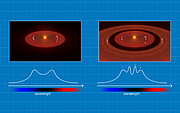
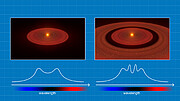
Wanneer sterren zoals de zon de eindfase van hun leven bereiken, zwellen ze op en stoten ze hun buitenste lagen af. Daarbij slokken ze nabijgelegen planeten op en vernietigen deze. De resterende rotsachtige hemellichamen kunnen uit elkaar vallen en zo een schijf vormen rond de centrale dode ster. De schijf rond J1328−1450 verschilt echter sterk van de schijven die rond andere dode sterren zijn waargenomen: rond de centrale ster is niet één ring van verdampte planetaire brokstukken te zien, maar een tweetal concentrische ringen.
‘De structuur die we in dit stelsel waarnemen, is bijzonder intrigerend omdat de beide ringen opmerkelijk stabiel zijn en door een opening van elkaar gescheiden blijven’, zegt medeauteur Felipe Lagos-Vilches, astronoom aan de Universiteit van Warwick in het Verenigd Koninkrijk en aan de Universidad Técnica Federico Santa María in Chili. ‘Het stelsel biedt een kijkje in het chaotische proces waarbij een planetenstelsel ten onder gaat, en het suggereert dat dode sterren schijfstructuren kunnen hebben die veel complexer zijn dan eerder werd aangenomen’, voegt Gentile Fusillo, die eveneens verbonden is aan het INAF-Astronomisch Observatorium van Triëst, daar aan toe.
Volgens het team wordt deze complexe dubbele structuur waarschijnlijk in stand gehouden door twee resterende planeetachtige hemellichamen, die in afzonderlijke banen draaien. Zij schatten dat het hemellichaam in de binnenste ring ongeveer zo groot is als een planetoïde (enkele kilometers), terwijl het hemellichaam in de buitenste ring zo groot zou kunnen zijn als Pluto of zelfs als onze maan.
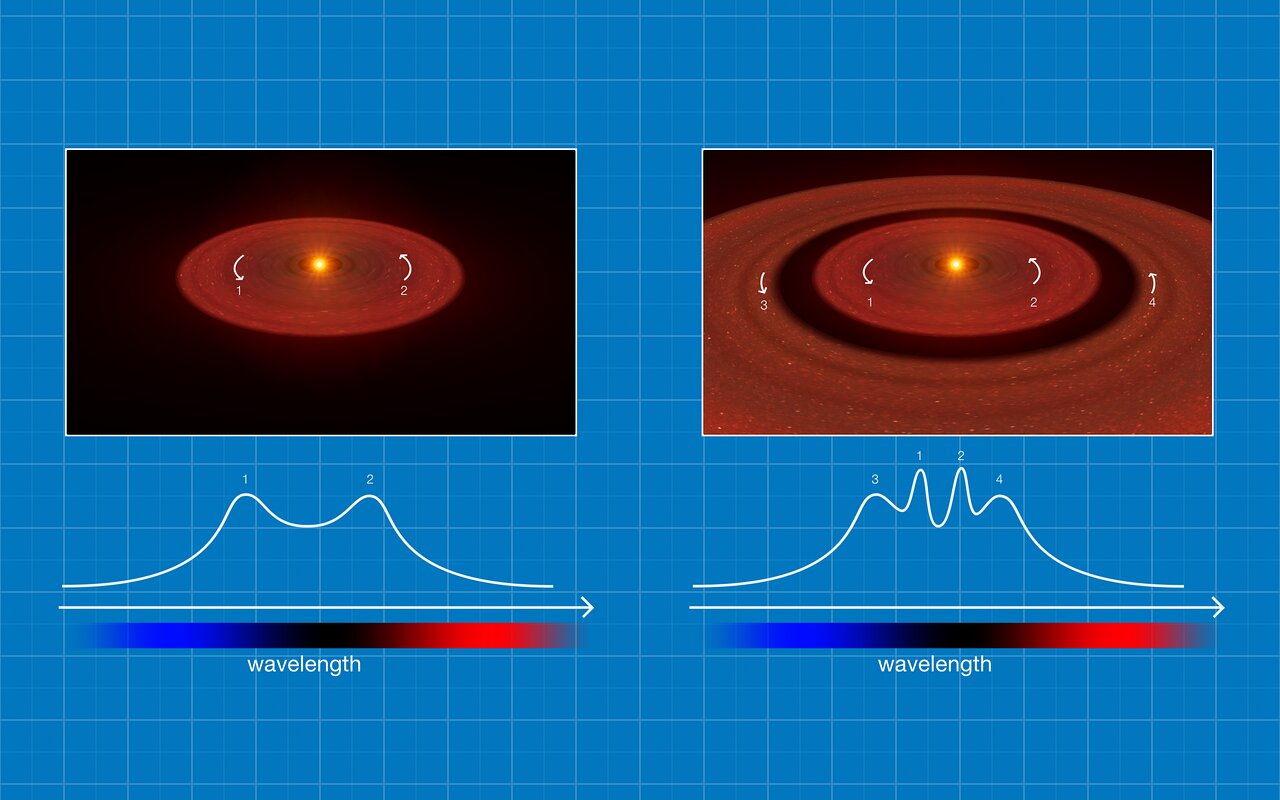
Alle bekende puinschijven rond witte dwergen vertonen dezelfde signatuur, die wijst op de aanwezigheid van één enkele, vlakke, draaiende schijf. Maar uit de nieuwe waarnemingen, uitgevoerd met het X-Shooter-instrument van de VLT van ESO in de Atacama-woestijn in Chili, blijkt dat het J1328−1450-systeem volledig afwijkt van dit patroon en in plaats daarvan de unieke kenmerken van een dubble schijf vertoont.
Uit de waarnemingen blijkt ook dat elementen zoals calcium, zuurstof, magnesium en ijzer in de schijf aanwezig zijn, wat wijst op een samenstelling die vergelijkbaar is met die van het rotsachtige planetaire materiaal in ons eigen zonnestelsel. Bovendien wijzen de gegevens erop dat de twee ringen in de schijf nogal in samenstelling verschillen: de binnenste ring is rijk aan magnesiumgas, terwijl de buitenste ring daar grotendeels van verstoken is. Dit suggereert dat de planetesimalen waaruit de ringen zijn opgebouwd afkomstig zijn van twee planeten met verschillende samenstellingen. Een andere verklaring is dat zij overblijfselen zijn van verschillende delen van één en hetzelfde hemellichaam, zoals de korst en de kern van een planeet.
Mogelijk staat ons zonnestelsel een vergelijkbaar einde te wachten, omdat onze zon in de verre toekomst een witte dwerg zal worden – een proces waarbij de aarde wellicht wordt vernietigd. ‘Het stelsel biedt daarom een opmerkelijke blik op hoe de toekomst van planetenstelsels zoals het onze eruit zouden kunnen zien’, concludeert Lagos-Vilches.
Meer informatie
De resultaten van dit onderzoek zijn te vinden in een artikel dat in Nature Astronomy verschijnt (doi: 10.1038/s41550-026-03004-3)
Het onderzoeksteam bestaat uit Nicola Pietro Gentile Fusillo (Dipartimento di Fisica, Universita‘ di Trieste en INAF-Osservatorio Astronomico di Trieste, Italië), Felipe Lagos-Vilches (Department of Physics, University of Warwick, VK en Departamento de Física, Universidad Técnica Federico Santa María, Chili), Boris T. Gänsicke (Department of Physics and Centre for Exoplanets and Habitability, University of Warwick, VK), Christopher J. Manser (Department of Physics, Astrophysics Group, Imperial College London, VK), Detlev Koester (Institut für Theoretische Physik und Astrophysik, Universiteit van Kiel, Duitsland).
De Europese Zuidelijke Sterrenwacht (ESO) stelt wetenschappers van over de hele wereld in staat om de geheimen van het heelal te ontdekken, ten bate van iedereen. Wij ontwerpen, bouwen en exploiteren observatoria van wereldklasse die door astronomen worden gebruikt om spannende vragen te beantwoorden en de fascinatie voor astronomie te verspreiden, en bevorderen internationale samenwerking op het gebied van de astronomie. ESO, in 1962 opgericht als intergouvernementele organisatie, wordt inmiddels gedragen door 16 lidstaten (België, Denemarken, Duitsland, Finland, Frankrijk, lerland, Italië, Nederland. Oostenrijk, Polen, Portugal, Spanje, Tsjechië, het Verenigd Koninkrijk, Zweden en Zwitserland) en door het gastland Chili, met Australië als strategische partner. Het hoofdkwartier van de ESO en haar bezoekerscentrum en planetarium, de ESO Supernova, zijn gevestigd nabij München in Duitsland, maar onze telescopen staan opgesteld in de Chileense Atacama-woestijn - een prachtige plek met unieke omstandigheden voor het doen van hemelwaarnemingen. ESO exploiteert drie waarnemingslocaties: La Silla, Paranal en Chajnantor. Op Paranal staan ESO's Very Large Telescope en Very Large Telescope Interferometer, evenals surveytelescopen zoals VISTA. Ook zal ESO op Paranal de Cherenkov Telescope Array South huisvesten en exploiteren -'s werelds grootste en gevoeligste observatorium van gammastraling. Samen met internationale partners beheert ESO APEX en ALMA op Chajnantor, twee faciliteiten die de hemel waarnemen in het millimeter- en submillimetergebied. Op Cerro Armazones, nabij Paranal, bouwen wij 'het grootste oog ter wereld' - ESO's Extremely Large Telescope. Vanuit onze kantoren in Santiago, Chili, ondersteunen wij onze activiteiten in het gastland en werken wij samen met Chileense partners en de Chileense samenleving.
Links
- Onderzoeksartikel
- Foto's van de VLT
- Voor journalisten: abonneer je op persberichten onder embargo in je eigen taal
- Voor wetenschappers: Heb je een verhaal? promoot je onderzoek
Contact
Nicola Pietro Gentile Fusillo
University of Trieste and INAF-Astronomical Observatory of Trieste
Trieste, Italy
Tel: +39 403199156
E-mail: nicola.gentilefusillo@gmail.com, nicolapietro.gentilefusillo@units.it
Felipe Esteban Lagos Vilches
Universidad Técnica Federico Santamaria
Valparaiso, Chile
E-mail: felipe.lagos.vilches@gmail.com
Bárbara Ferreira
ESO Media Manager
Garching bei München, Germany
Tel: +49 89 3200 6670
Mobiel: +49 151 241 664 00
E-mail: press@eso.org
Marieke Baan (Perscontact Nederland)
ESO Science Outreach Network
en NOVA Informatie Centrum
Tel: +31(0)20-5257480
E-mail: eson-netherlands@eso.org
Over dit bericht
| Persberichten nr.: | eso2613nl |
| Naam: | J1328−1450 |
| Type: | Milky Way : Star : Circumstellar Material : Planetary System |
| Facility: | Very Large Telescope |
| Instruments: | X-shooter |
Afbeeldingen
Video's
Our use of Cookies
We use cookies that are essential for accessing our websites and using our services. We also use cookies to analyse, measure and improve our websites’ performance, to enable content sharing via social media and to display media content hosted on third-party platforms.
ESO Cookies Policy
The European Organisation for Astronomical Research in the Southern Hemisphere (ESO) is the pre-eminent intergovernmental science and technology organisation in astronomy. It carries out an ambitious programme focused on the design, construction and operation of powerful ground-based observing facilities for astronomy.
This Cookies Policy is intended to provide clarity by outlining the cookies used on the ESO public websites, their functions, the options you have for controlling them, and the ways you can contact us for additional details.
What are cookies?
Cookies are small pieces of data stored on your device by websites you visit. They serve various purposes, such as remembering login credentials and preferences and enhance your browsing experience.
Categories of cookies we use
Essential cookies (always active): These cookies are strictly necessary for the proper functioning of our website. Without these cookies, the website cannot operate correctly, and certain services, such as logging in or accessing secure areas, may not be available; because they are essential for the website’s operation, they cannot be disabled.
Functional Cookies: These cookies enhance your browsing experience by enabling additional features and personalization, such as remembering your preferences and settings. While not strictly necessary for the website to function, they improve usability and convenience; these cookies are only placed if you provide your consent.
Analytics cookies: These cookies collect information about how visitors interact with our website, such as which pages are visited most often and how users navigate the site. This data helps us improve website performance, optimize content, and enhance the user experience; these cookies are only placed if you provide your consent. We use the following analytics cookies.
Matomo Cookies:
This website uses Matomo (formerly Piwik), an open source software which enables the statistical analysis of website visits. Matomo uses cookies (text files) which are saved on your computer and which allow us to analyze how you use our website. The website user information generated by the cookies will only be saved on the servers of our IT Department. We use this information to analyze www.eso.org visits and to prepare reports on website activities. These data will not be disclosed to third parties.
On behalf of ESO, Matomo will use this information for the purpose of evaluating your use of the website, compiling reports on website activity and providing other services relating to website activity and internet usage.
Matomo cookies settings:
Additional Third-party cookies on ESO websites: some of our pages display content from external providers, e.g. YouTube.
Such third-party services are outside of ESO control and may, at any time, change their terms of service, use of cookies, etc.
YouTube: Some videos on the ESO website are embedded from ESO’s official YouTube channel. We have enabled YouTube’s privacy-enhanced mode, meaning that no cookies are set unless the user actively clicks on the video to play it. Additionally, in this mode, YouTube does not store any personally identifiable cookie data for embedded video playbacks. For more details, please refer to YouTube’s embedding videos information page.
Cookies can also be classified based on the following elements.
Regarding the domain, there are:
- First-party cookies, set by the website you are currently visiting. They are stored by the same domain that you are browsing and are used to enhance your experience on that site;
- Third-party cookies, set by a domain other than the one you are currently visiting.
As for their duration, cookies can be:
- Browser-session cookies, which are deleted when the user closes the browser;
- Stored cookies, which stay on the user's device for a predetermined period of time.
How to manage cookies
Cookie settings: You can modify your cookie choices for the ESO webpages at any time by clicking on the link Cookie settings at the bottom of any page.
In your browser: If you wish to delete cookies or instruct your browser to delete or block cookies by default, please visit the help pages of your browser:
Please be aware that if you delete or decline cookies, certain functionalities of our website may be not be available and your browsing experience may be affected.
You can set most browsers to prevent any cookies being placed on your device, but you may then have to manually adjust some preferences every time you visit a site/page. And some services and functionalities may not work properly at all (e.g. profile logging-in, shop check out).
Updates to the ESO Cookies Policy
The ESO Cookies Policy may be subject to future updates, which will be made available on this page.
Additional information
For any queries related to cookies, please contact: pdprATesoDOTorg.
As ESO public webpages are managed by our Department of Communication, your questions will be dealt with the support of the said Department.