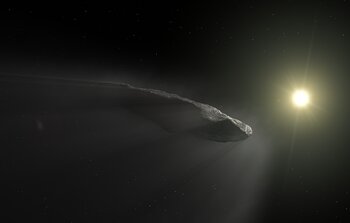
Usando il VLT (Very Large Telescope) dell'Osservatorio Europeo Australe (ESO) alcuni astronomi hanno scoperto l'assenza di una stella massiccia instabile in una galassia nana. Gli scienziati pensano che ciò potrebbe indicare che la stella è diventata meno luminosa e parzialmente oscurata dalla polvere. Una spiegazione alternativa è che la stella sia collassata a formare un buco nero senza produrre una supernova. "Se fosse vero", afferma lo studente di dottorato Andrew Allan del Trinity College di Dublino, in Irlanda, a capo dell'equipe "questa sarebbe la prima individuazione diretta di una stella gigantesca che termina così la propria vita".
Testo immagini e video disponibili su:
https://www.eso.org/public/italy/news/eso2010/
Cordiali saluti,
The ESO Department of Communication
30 Giugno 2020
|
25 Giugno 2020: Astronomers use telescopes to peer into far away planetary systems, seeking to uncover the mysteries of their formation and evolution and reveal how they compare to our own. Occasionally though ...
|
| Leggi ancora |

|
Interview with Pierre Léna
26 Giugno 2020: Observing infrared light from the Universe reveals objects that are difficult or impossible to see in other types of light. In particular, infrared astronomy is useful for exploring cool, dusty ...
|
| Leggi ancora |

|
Interview with Johann Kolb
12 Giugno 2020: Johann Kolb is an expert in adaptive optics — the correction of the distortion of light caused by turbulence in Earth’s atmosphere. Involving advanced technologies like deformable mirrors and powerful ...
|
| Leggi ancora |
|
|
|
|