Press Release
Dead star and planetary bodies: astronomers spot unique disc of debris that foretells Solar System’s future
27 October 2026
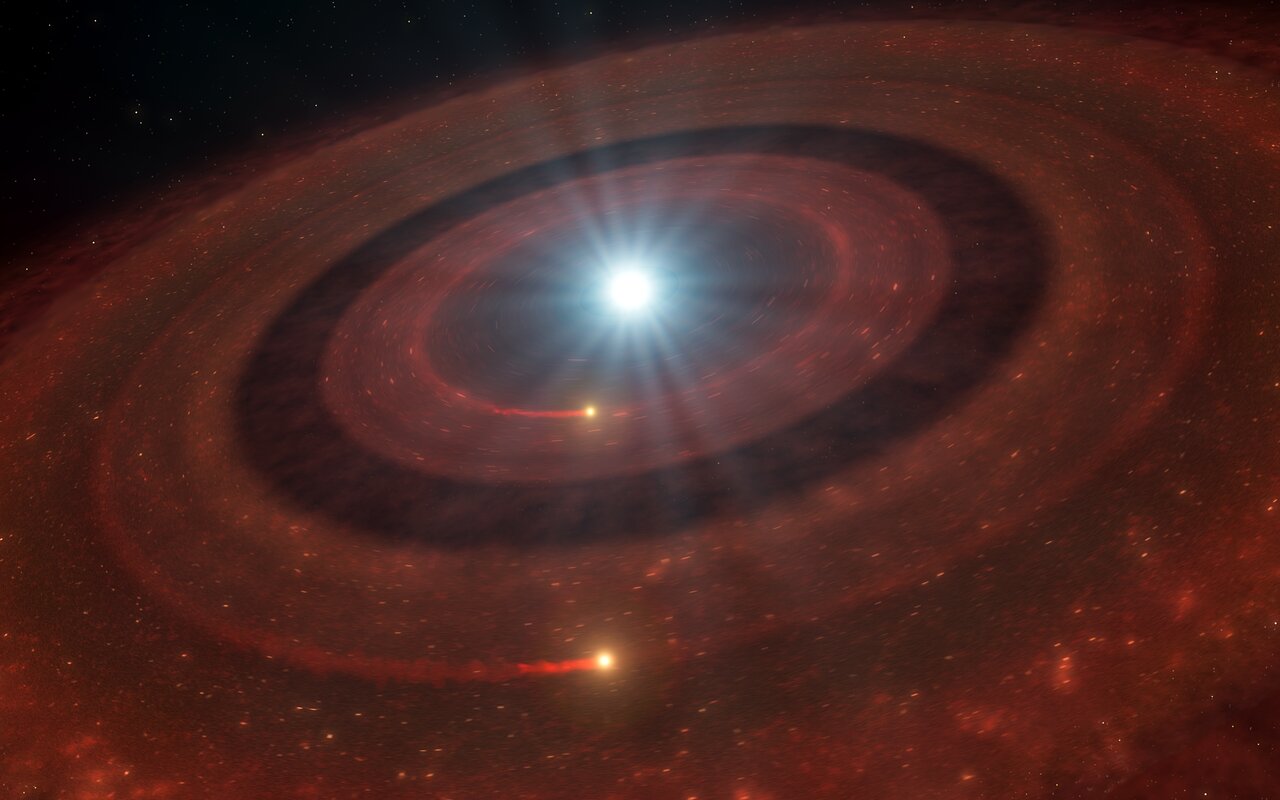
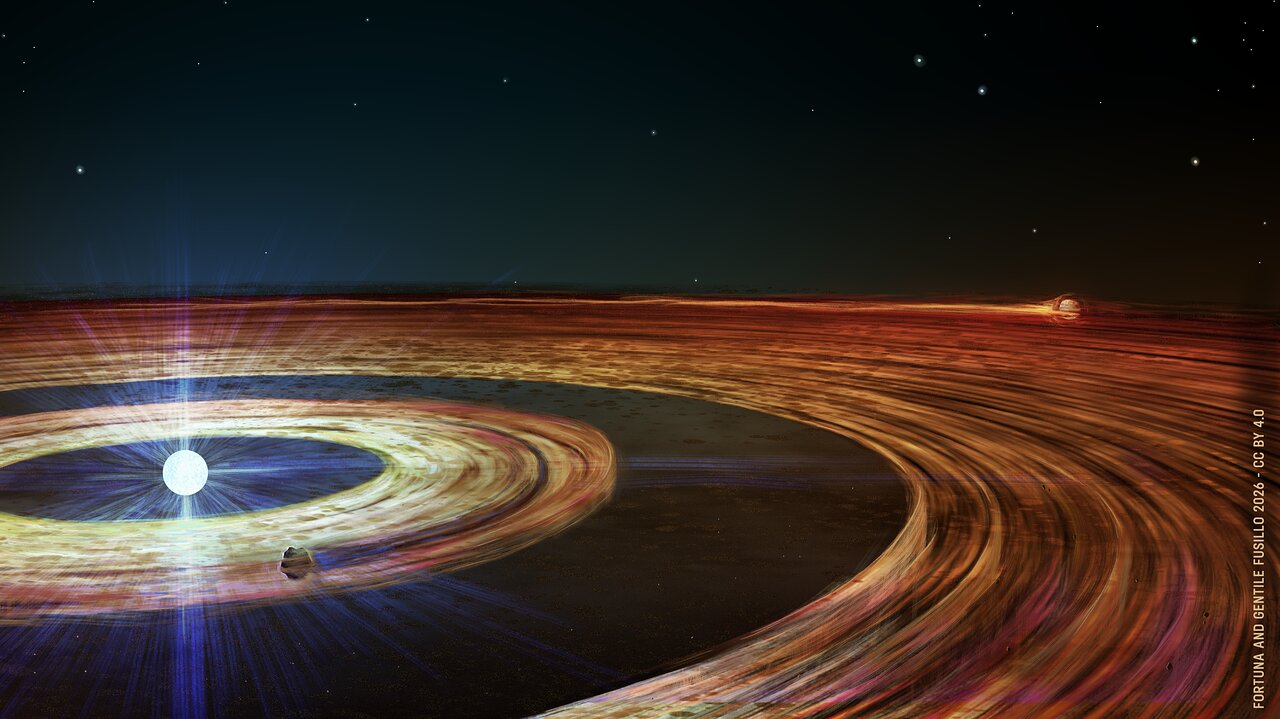
Astronomers using the European Southern Observatory’s Very Large Telescope (ESO’s VLT) have found a rare disc of debris around a dead star that provides a glimpse of what may happen to our Solar System. Unlike in similar systems previously found, the debris — the leftovers of planets that once orbited the star — is organised in a double disc, the two parts separated by a clear gap. The disc appears to be shaped by two planetary bodies, one possibly as big as Pluto, that have survived the violent death of the star.
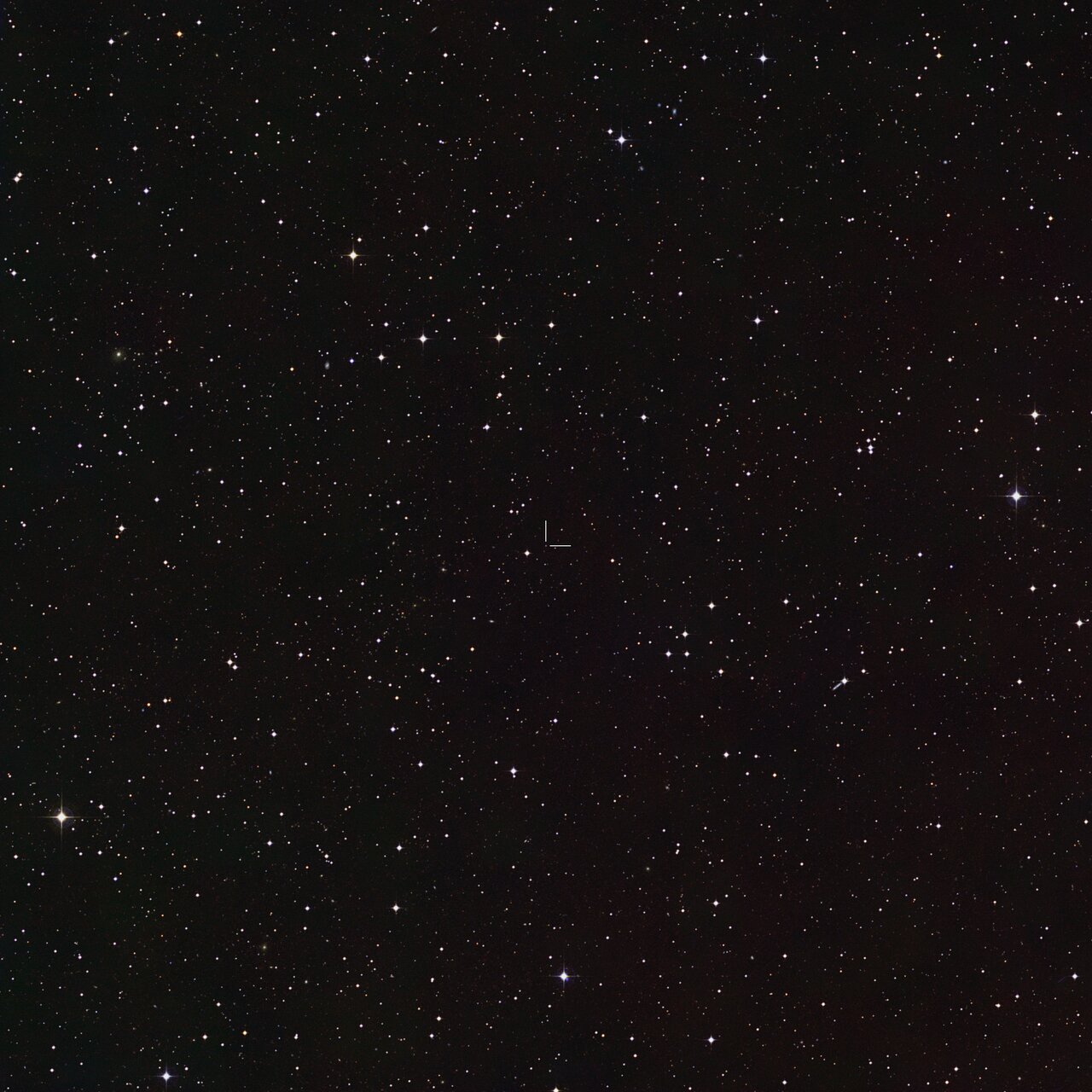
“We have known for some time that planets may survive beyond the transformation of their central star, but this is the first example of a complex system with a double debris disc and potentially two surviving planetesimals,” says Nicola Gentille Fusillo, astronomer at the Università degli Studi di Trieste, Italy, and lead author of the study published this week in Nature Astronomy. The central star of this system is the white dwarf J1328−1450, the dense and burnt-out core left behind when a star similar to our Sun ran out of fuel.
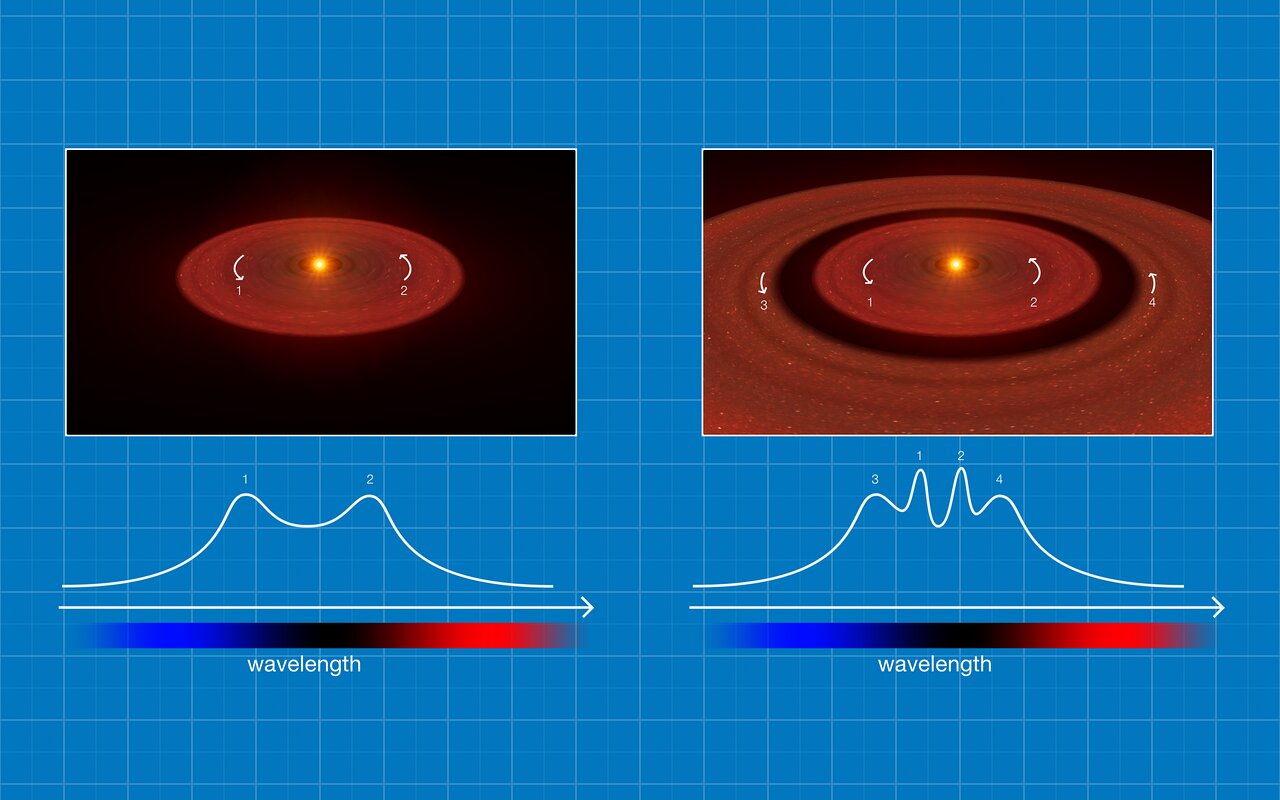
As stars like the Sun enter the final stages of their life, they expand and shed their outer layers, engulfing and destroying nearby planets. The surviving rocky bodies can break apart forming a disc around the central, dead star. However, the disc around J1328−1450 is different from those observed around other dead stars: instead of having only one ring of vaporised planetary rubble, the star is surrounded by two concentric debris rings.
“The structure we see in this system is particularly intriguing because the two gaseous rings are remarkably stable and remain separated by a gap,” says co-author Felipe Lagos-Vilches, an astronomer at the University of Warwick, UK and at the Universidad Técnica Federico Santa María in Chile. “The system is a rare glimpse of the violent, chaotic process by which a planetary system meets its end, and it hints that dead stars can have disc structures far more complex than previously realised,” adds Gentile Fusillo, who is also affiliated with the INAF-Astronomical Observatory of Trieste.
According to the team, this complex double structure is likely maintained by two surviving planet-like bodies, on separate orbits. They estimate that the one in the inner ring is the size of a typical asteroid, a few kilometres in diameter, while the outer one could be as large as Pluto, or even our Moon.
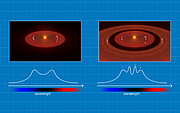
All known debris discs around white dwarfs have been identified by the same observational signature, which indicates the presence of a single, flat, rotating disc. But the new observations, made with the X-Shooter instrument on ESO’s VLT in Chile’s Atacama Desert, show that the J1328−1450 system breaks this pattern completely, revealing instead the unique fingerprint of a double disc.
The observations also reveal that elements such as calcium, oxygen, magnesium and iron are present in the disc, indicating a composition similar to that of rocky planetary material found in our own Solar System. Moreover, the data indicate that the two rings in the disc in fact have rather different compositions, with the inner ring rich in magnesium gas and the outer largely stripped of it. This suggests that the planetesimals that feed the rings originated from two planets with different compositions. An alternative explanation is that they are the result of different parts of a celestial body, like the crust and core of a planet.
Our Solar System could meet a similar end, as our Sun will, in a far future, become a white dwarf in a process that may destroy Earth. “The system therefore offers a remarkable glimpse of what the future of planetary systems, including systems like our own, might look like,” concludes Lagos-Vilches.
More information
This research was presented in a paper published in Nature Astronomy (doi: 10.1038/s41550-026-03004-3).
The team is composed of Nicola Pietro Gentile Fusillo (Dipartimento di Fisica, Universita‘ di Trieste and INAF-Osservatorio Astronomico di Trieste, Italy), Felipe Lagos-Vilches (Department of Physics, University of Warwick, UK and Departamento de Física, Universidad Técnica Federico Santa María, Chile), Boris T. Gänsicke (Department of Physics and Centre for Exoplanets and Habitability, University of Warwick, UK), Christopher J. Manser (Department of Physics, Astrophysics Group, Imperial College London, UK), Detlev Koester (Institut für Theoretische Physik und Astrophysik, University of Kiel, Germany).
The European Southern Observatory (ESO) enables scientists worldwide to discover the secrets of the Universe for the benefit of all. We design, build and operate world-class observatories on the ground — which astronomers use to tackle exciting questions and spread the fascination of astronomy — and promote international collaboration for astronomy. Established as an intergovernmental organisation in 1962, today ESO is supported by 16 Member States (Austria, Belgium, Czechia, Denmark, France, Finland, Germany, Ireland, Italy, the Netherlands, Poland, Portugal, Spain, Sweden, Switzerland and the United Kingdom), along with the host state of Chile and with Australia as a Strategic Partner. ESO’s headquarters and its visitor centre and planetarium, the ESO Supernova, are located close to Munich in Germany, while the Chilean Atacama Desert, a marvellous place with unique conditions to observe the sky, hosts our telescopes. ESO operates three observing sites: La Silla, Paranal and Chajnantor. At Paranal, ESO operates the Very Large Telescope and its Very Large Telescope Interferometer, as well as survey telescopes such as VISTA. Also at Paranal, ESO will host and operate the south array of the Cherenkov Telescope Array Observatory, the world’s largest and most sensitive gamma-ray observatory. Together with international partners, ESO operates ALMA on Chajnantor, a facility that observes the skies in the millimetre and submillimetre range. At Cerro Armazones, near Paranal, we are building “the world’s biggest eye on the sky” — ESO’s Extremely Large Telescope. From our offices in Santiago, Chile we support our operations in the country and engage with Chilean partners and society.
Links
- Research paper
- Photos of the VLT
- For journalists: subscribe to receive our releases under embargo in your language
- For scientists: got a story? Pitch your research
Contacts
Nicola Pietro Gentile Fusillo
University of Trieste and INAF-Astronomical Observatory of Trieste
Trieste, Italy
Tel: +39 403199156
Email: nicola.gentilefusillo@gmail.com, nicolapietro.gentilefusillo@units.it
Felipe Esteban Lagos Vilches
Universidad Técnica Federico Santamaria
Valparaiso, Chile
Email: felipe.lagos.vilches@gmail.com
Bárbara Ferreira
ESO Media Manager
Garching bei München, Germany
Tel: +49 89 3200 6670
Cell: +49 151 241 664 00
Email: press@eso.org
About the Release
| Release No.: | eso2613 |
| Name: | J1328−1450 |
| Type: | Milky Way : Star : Circumstellar Material : Planetary System |
| Facility: | Very Large Telescope |
| Instruments: | X-shooter |
Images

Videos


Our use of Cookies
We use cookies that are essential for accessing our websites and using our services. We also use cookies to analyse, measure and improve our websites’ performance, to enable content sharing via social media and to display media content hosted on third-party platforms.
ESO Cookies Policy
The European Organisation for Astronomical Research in the Southern Hemisphere (ESO) is the pre-eminent intergovernmental science and technology organisation in astronomy. It carries out an ambitious programme focused on the design, construction and operation of powerful ground-based observing facilities for astronomy.
This Cookies Policy is intended to provide clarity by outlining the cookies used on the ESO public websites, their functions, the options you have for controlling them, and the ways you can contact us for additional details.
What are cookies?
Cookies are small pieces of data stored on your device by websites you visit. They serve various purposes, such as remembering login credentials and preferences and enhance your browsing experience.
Categories of cookies we use
Essential cookies (always active): These cookies are strictly necessary for the proper functioning of our website. Without these cookies, the website cannot operate correctly, and certain services, such as logging in or accessing secure areas, may not be available; because they are essential for the website’s operation, they cannot be disabled.
Functional Cookies: These cookies enhance your browsing experience by enabling additional features and personalization, such as remembering your preferences and settings. While not strictly necessary for the website to function, they improve usability and convenience; these cookies are only placed if you provide your consent.
Analytics cookies: These cookies collect information about how visitors interact with our website, such as which pages are visited most often and how users navigate the site. This data helps us improve website performance, optimize content, and enhance the user experience; these cookies are only placed if you provide your consent. We use the following analytics cookies.
Matomo Cookies:
This website uses Matomo (formerly Piwik), an open source software which enables the statistical analysis of website visits. Matomo uses cookies (text files) which are saved on your computer and which allow us to analyze how you use our website. The website user information generated by the cookies will only be saved on the servers of our IT Department. We use this information to analyze www.eso.org visits and to prepare reports on website activities. These data will not be disclosed to third parties.
On behalf of ESO, Matomo will use this information for the purpose of evaluating your use of the website, compiling reports on website activity and providing other services relating to website activity and internet usage.
Matomo cookies settings:
Additional Third-party cookies on ESO websites: some of our pages display content from external providers, e.g. YouTube.
Such third-party services are outside of ESO control and may, at any time, change their terms of service, use of cookies, etc.
YouTube: Some videos on the ESO website are embedded from ESO’s official YouTube channel. We have enabled YouTube’s privacy-enhanced mode, meaning that no cookies are set unless the user actively clicks on the video to play it. Additionally, in this mode, YouTube does not store any personally identifiable cookie data for embedded video playbacks. For more details, please refer to YouTube’s embedding videos information page.
Cookies can also be classified based on the following elements.
Regarding the domain, there are:
- First-party cookies, set by the website you are currently visiting. They are stored by the same domain that you are browsing and are used to enhance your experience on that site;
- Third-party cookies, set by a domain other than the one you are currently visiting.
As for their duration, cookies can be:
- Browser-session cookies, which are deleted when the user closes the browser;
- Stored cookies, which stay on the user's device for a predetermined period of time.
How to manage cookies
Cookie settings: You can modify your cookie choices for the ESO webpages at any time by clicking on the link Cookie settings at the bottom of any page.
In your browser: If you wish to delete cookies or instruct your browser to delete or block cookies by default, please visit the help pages of your browser:
Please be aware that if you delete or decline cookies, certain functionalities of our website may be not be available and your browsing experience may be affected.
You can set most browsers to prevent any cookies being placed on your device, but you may then have to manually adjust some preferences every time you visit a site/page. And some services and functionalities may not work properly at all (e.g. profile logging-in, shop check out).
Updates to the ESO Cookies Policy
The ESO Cookies Policy may be subject to future updates, which will be made available on this page.
Additional information
For any queries related to cookies, please contact: pdprATesoDOTorg.
As ESO public webpages are managed by our Department of Communication, your questions will be dealt with the support of the said Department.