Une los puntos
Une los puntos
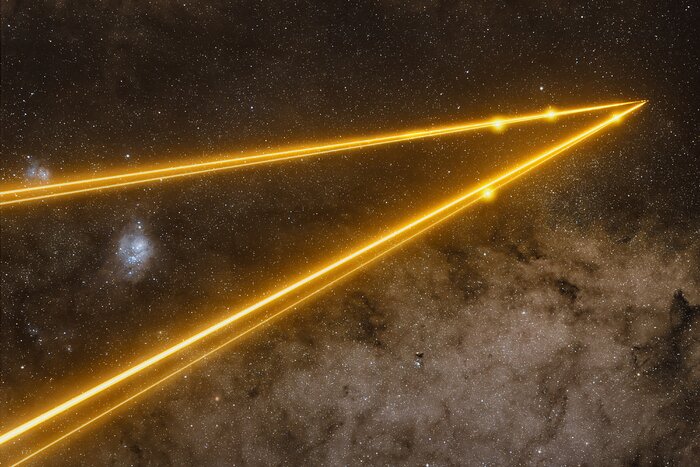
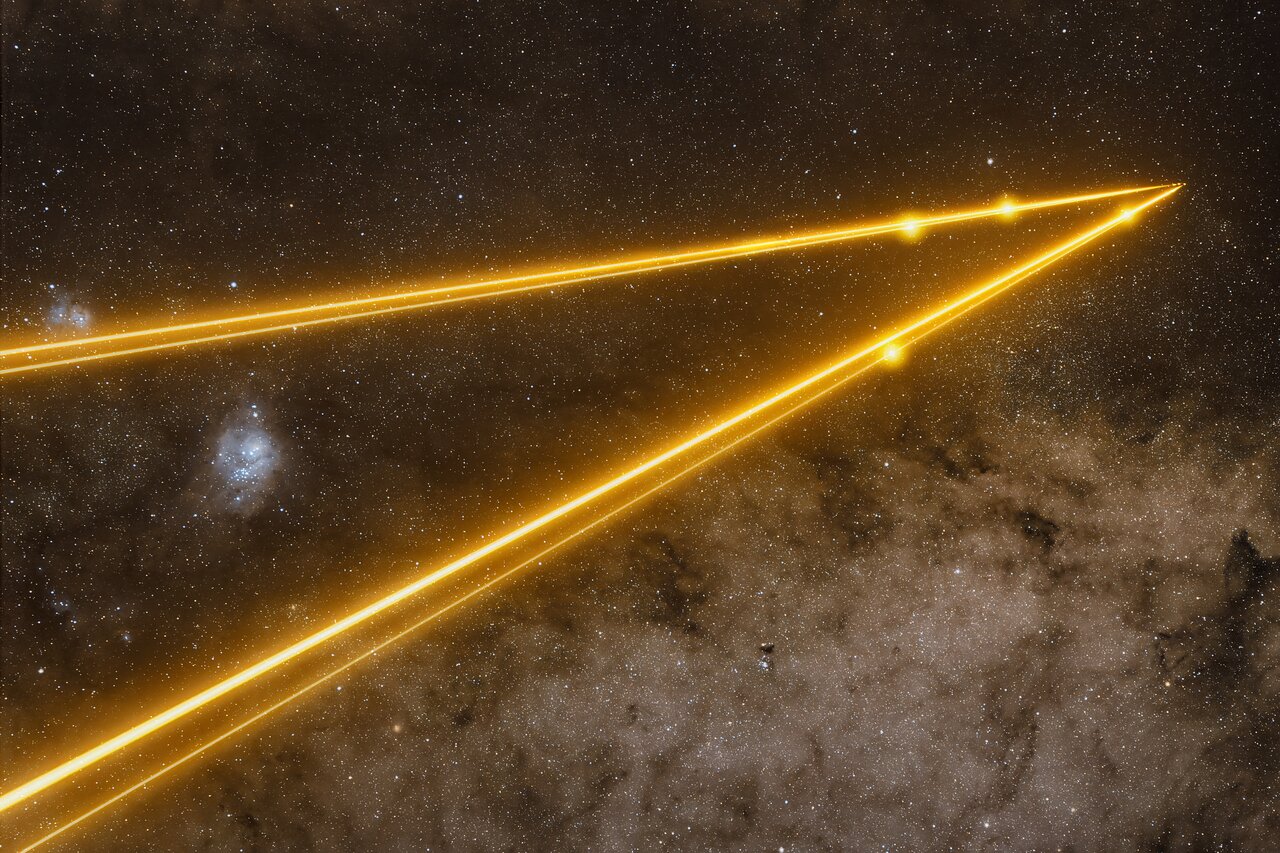
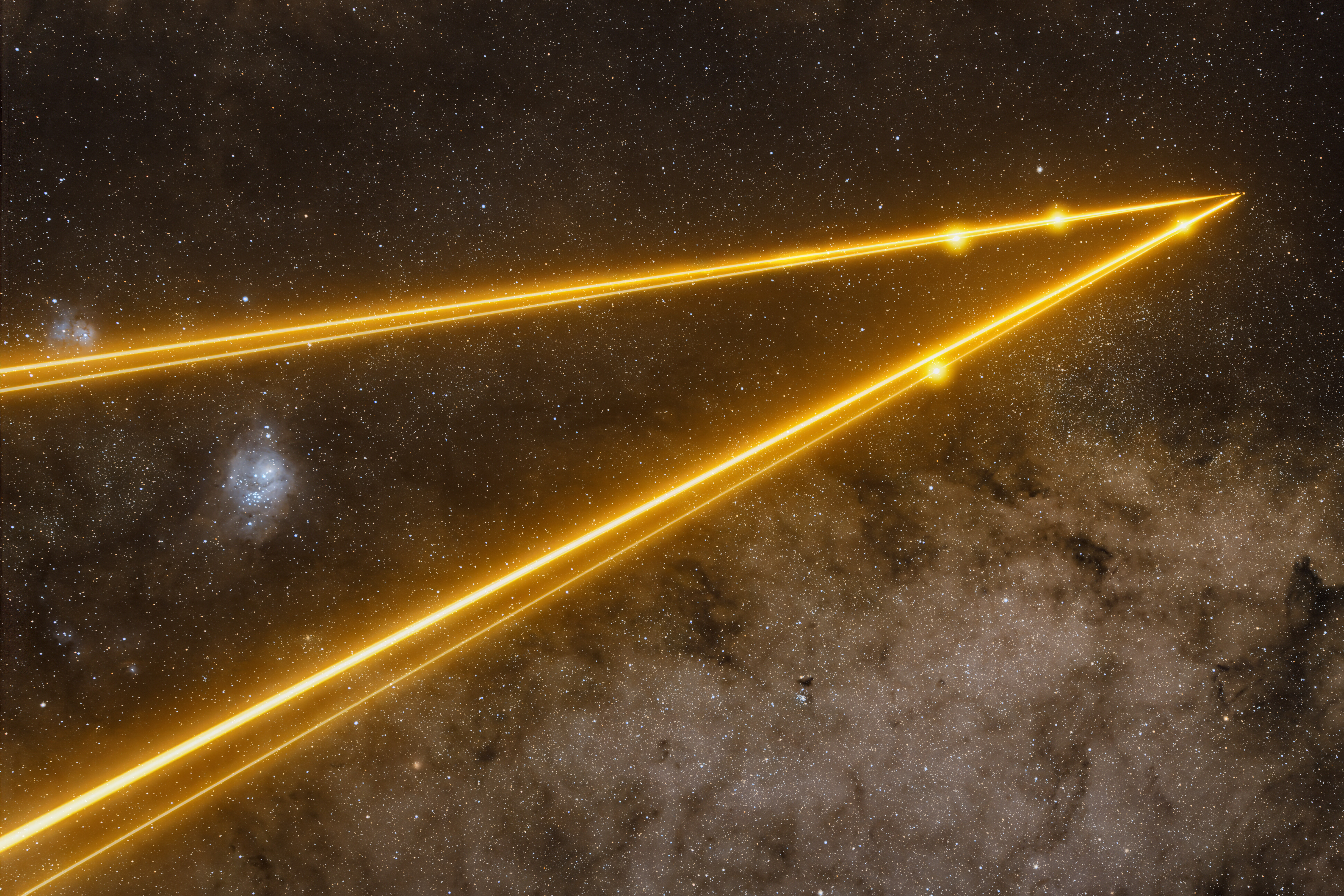
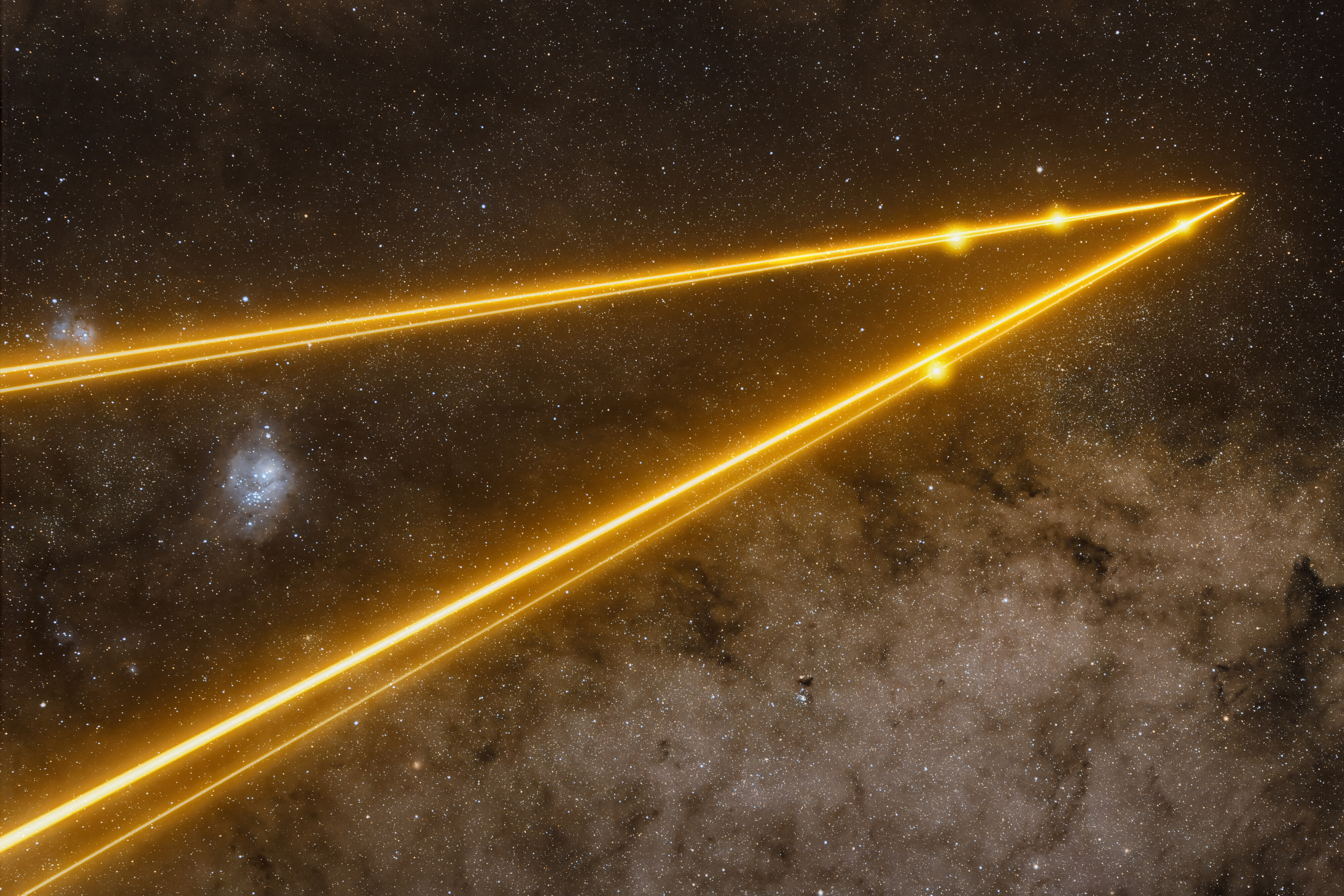
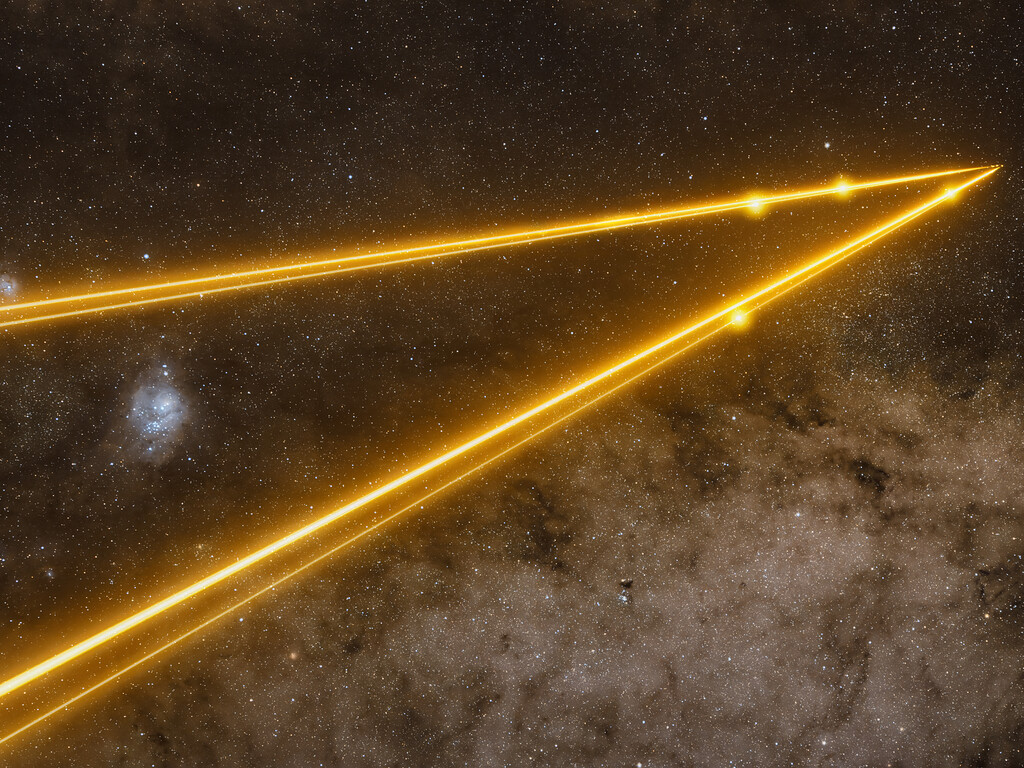
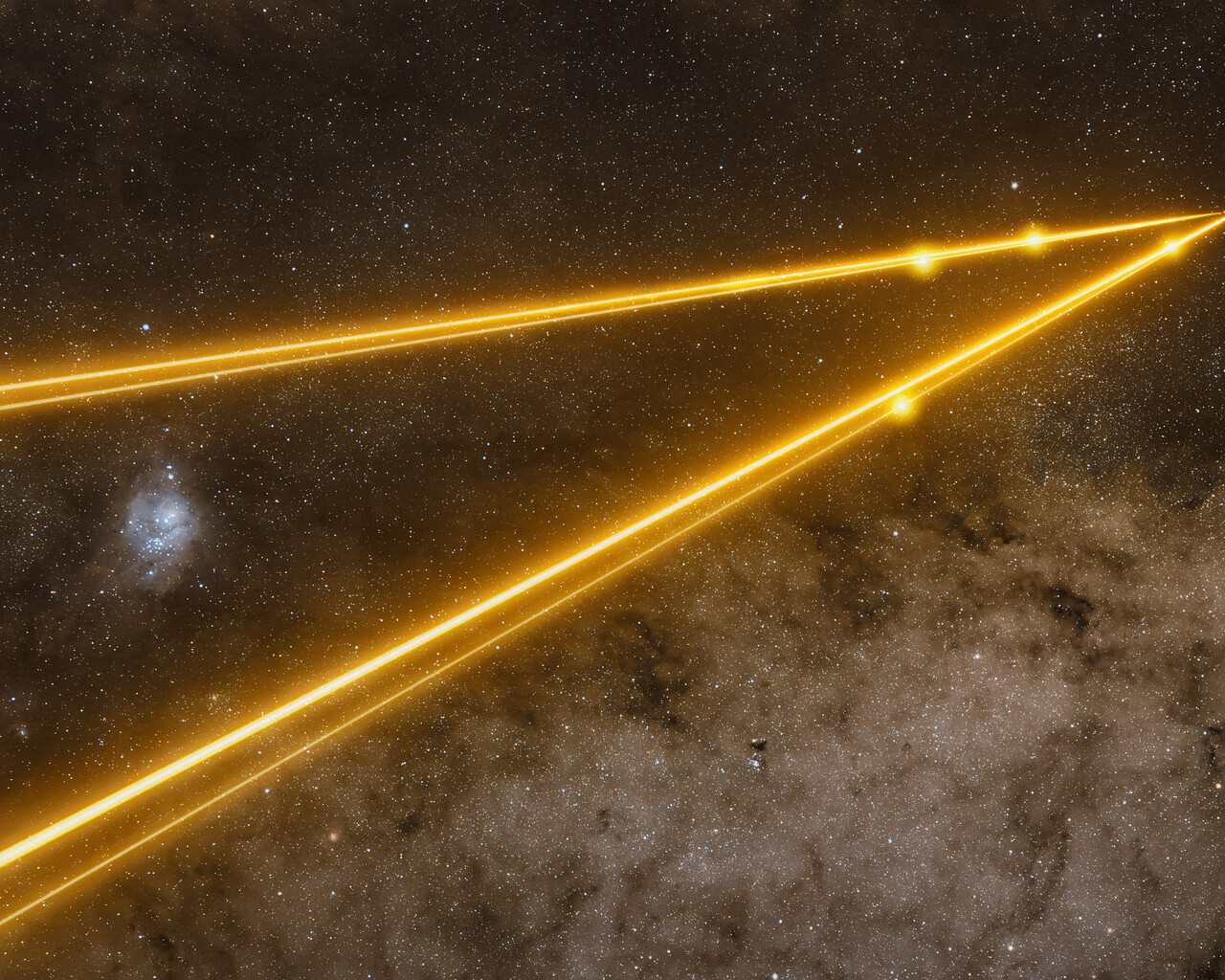
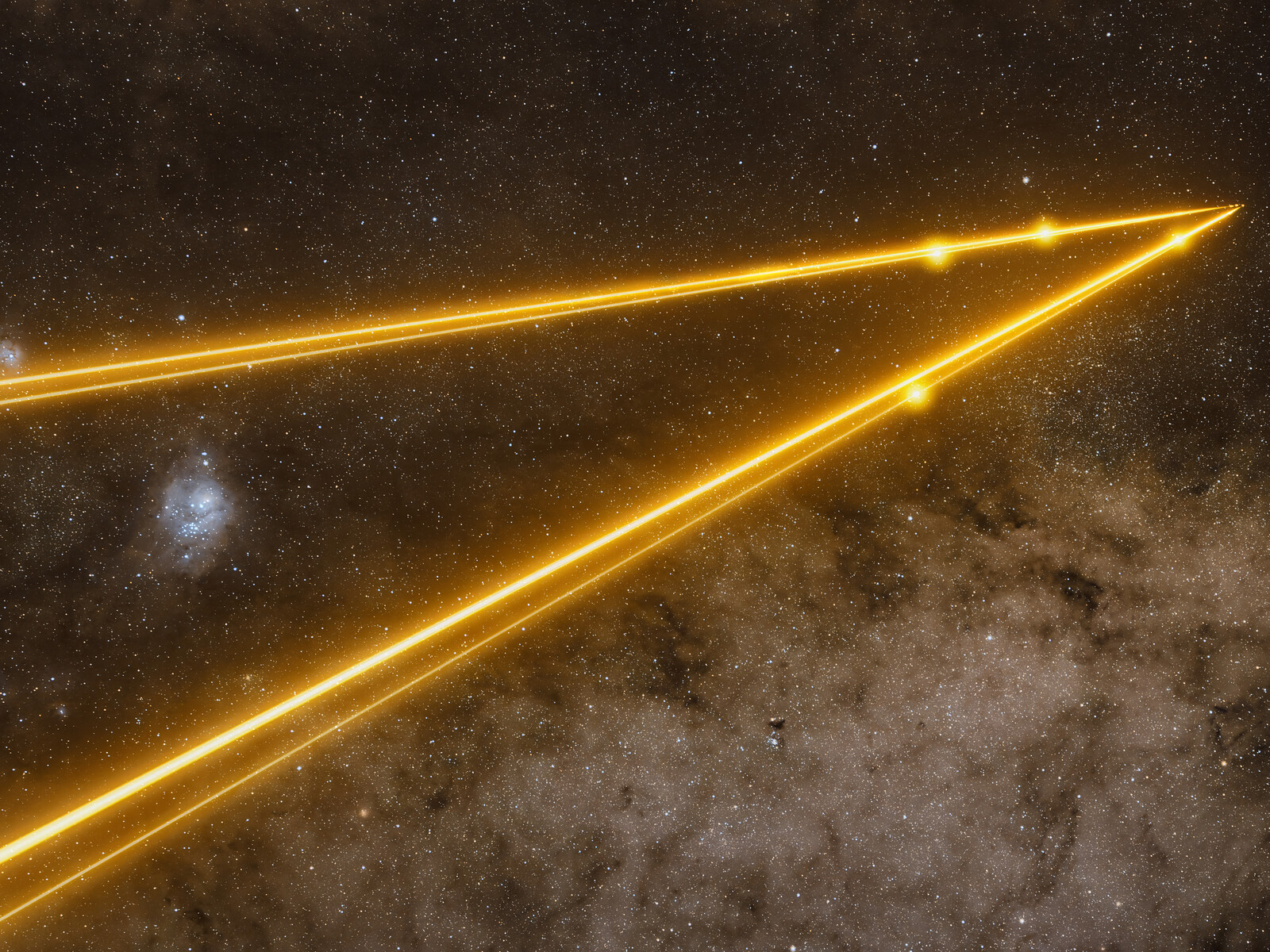
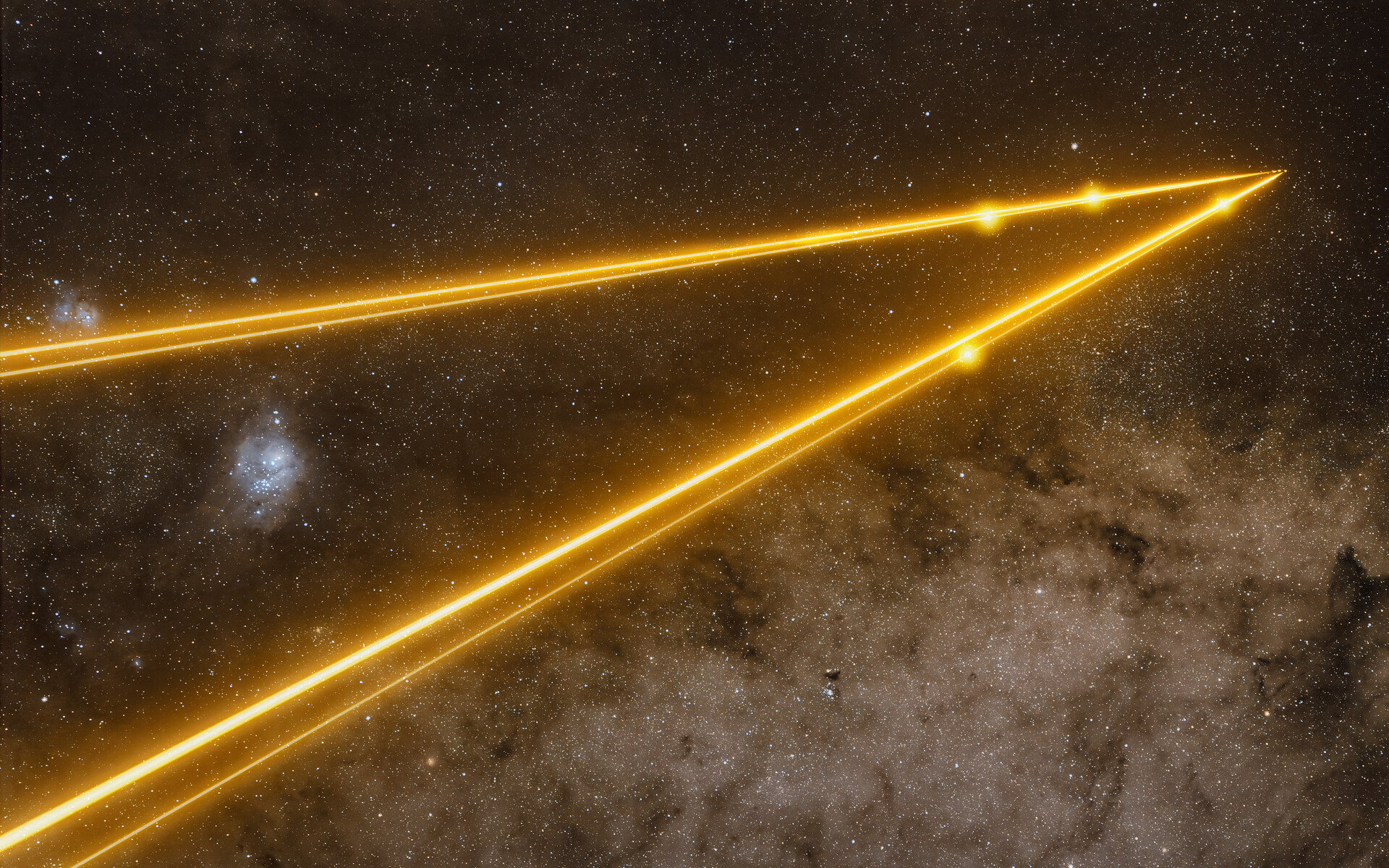
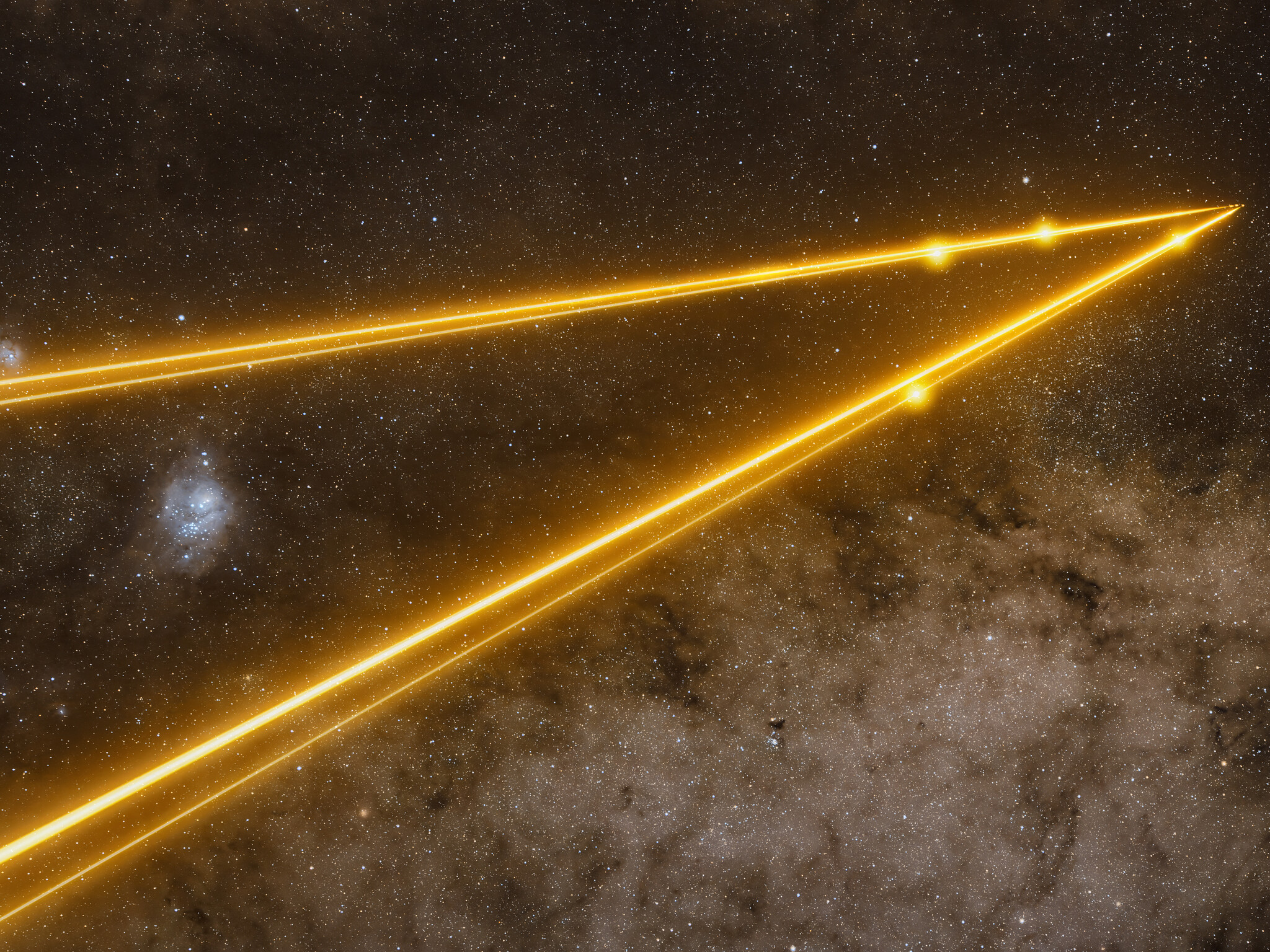
Cuatro rayos láser brillan sobre el magnífico cielo austral en esta Imagen de la Semana. En cada haz, vemos gotas de luz brillante, creadas por finas capas de nubes que se cruzan en el camino de los láseres y nos indican la fuente de estos haces. Emitidos por las cuatro Unidades de Telescopio (UT) del Very Large Telescope (VLT) de ESO (en esta imagen, trabajando juntos como parte del VLTI, el Interferómetro del VLT), la forma de los cuatro puntos brillantes refleja la disposición de las UT. Pero estas manchas fueron un feliz accidente causado por nubes que casualmente se interponían (los láseres en realidad apuntan a una capa mucho más alta de nuestra atmósfera).
Desde noviembre de 2025, las cuatro UT están equipadas con láseres como parte de una serie de mejoras significativas del VLTI denominadas GRAVITY+. Cada láser crea una "estrella" artificial, a 90 kilómetros sobre la superficie terrestre, utilizada para detectar cómo la atmósfera en movimiento distorsiona la luz entrante. Esto permite a un telescopio realizar correcciones en tiempo real que anulan el efecto de emborronamiento de la atmósfera. La luz "sin difuminar" de las cuatro UT puede combinarse para realizar observaciones detalladas de objetos cósmicos distantes. Esta mejora ha desbloqueado todo el cielo del sur al VLTI, permitiendo al sistema observar objetos mucho más tenues que antes.
En esta imagen, los telescopios y los láseres apuntan al centro de nuestra galaxia, la región alrededor del agujero negro supermasivo Sagitario A*. Si observa detenidamente el vértice del triángulo láser, podrá distinguir las cuatro diminutas estrellas artificiales creadas por los haces. Observar de forma más detallada el corazón de la Vía Láctea es una motivación científica clave para GRAVITY+, en particular para entender las propiedades de nuestro agujero negro supermasivo.
"Para mí, esta imagen es un logro", declara Anthony Berdeu, fotógrafo y astrónomo de ESO que trabaja en el proyecto GRAVITY+ desde 2022. "Fueron años intensos, desafiantes, pero fascinantes, en los que tuve la oportunidad de trabajar con grandes personas, con mucho talento, del consorcio y de ESO", reflexiona. Tras años de duro trabajo implementando las mejoras, "la primera noche en la que los láseres se enfocaron hacia el centro galáctico, tenía que estar en la plataforma VLT para hacer una foto”. Su fotografía capta no solo los cuatro láseres —que parecen atravesar la mancha oscura donde nubes de polvo cósmico cubren el centro galáctico— sino también la brillante banda de la Vía Láctea en la parte inferior derecha y, a la izquierda, la nebulosa de la Laguna y la nebulosa Trífida (ambas a unos 5000 años luz de distancia). Además, Berdeu tuvo una "agradable sorpresa" cuando una fina nube que estaba de paso interceptó los láseres, mostrando el contorno de las UT en puntos dorados, "añadiendo algo de dramatismo a la escena".
Enlaces
- Versión de esta imagen con la disposición del telescopio y anotaciones
- Vídeo timelapse de los láseres atravesando las nubes
A. Berdeu/ESO
Sobre la imagen
| Identificador: | potw2621a |
| Idioma: | es-cl |
| Tipo: | Fotográfico |
| Fecha de publicación: | 25 de Mayo de 2026 a las 06:00 |
| Tamaño: | 6864 x 4576 px |
Sobre el objeto
| Nombre: | Laser Guide Star, Very Large Telescope, Very Large Telescope Interferometer, VLT Unit Telescopes |
| Tipo: | Unspecified : Technology : Observatory |
Formatos de imagen


Our use of Cookies
We use cookies that are essential for accessing our websites and using our services. We also use cookies to analyse, measure and improve our websites’ performance, to enable content sharing via social media and to display media content hosted on third-party platforms.
ESO Cookies Policy
The European Organisation for Astronomical Research in the Southern Hemisphere (ESO) is the pre-eminent intergovernmental science and technology organisation in astronomy. It carries out an ambitious programme focused on the design, construction and operation of powerful ground-based observing facilities for astronomy.
This Cookies Policy is intended to provide clarity by outlining the cookies used on the ESO public websites, their functions, the options you have for controlling them, and the ways you can contact us for additional details.
What are cookies?
Cookies are small pieces of data stored on your device by websites you visit. They serve various purposes, such as remembering login credentials and preferences and enhance your browsing experience.
Categories of cookies we use
Essential cookies (always active): These cookies are strictly necessary for the proper functioning of our website. Without these cookies, the website cannot operate correctly, and certain services, such as logging in or accessing secure areas, may not be available; because they are essential for the website’s operation, they cannot be disabled.
Functional Cookies: These cookies enhance your browsing experience by enabling additional features and personalization, such as remembering your preferences and settings. While not strictly necessary for the website to function, they improve usability and convenience; these cookies are only placed if you provide your consent.
Analytics cookies: These cookies collect information about how visitors interact with our website, such as which pages are visited most often and how users navigate the site. This data helps us improve website performance, optimize content, and enhance the user experience; these cookies are only placed if you provide your consent. We use the following analytics cookies.
Matomo Cookies:
This website uses Matomo (formerly Piwik), an open source software which enables the statistical analysis of website visits. Matomo uses cookies (text files) which are saved on your computer and which allow us to analyze how you use our website. The website user information generated by the cookies will only be saved on the servers of our IT Department. We use this information to analyze www.eso.org visits and to prepare reports on website activities. These data will not be disclosed to third parties.
On behalf of ESO, Matomo will use this information for the purpose of evaluating your use of the website, compiling reports on website activity and providing other services relating to website activity and internet usage.
Matomo cookies settings:
Additional Third-party cookies on ESO websites: some of our pages display content from external providers, e.g. YouTube.
Such third-party services are outside of ESO control and may, at any time, change their terms of service, use of cookies, etc.
YouTube: Some videos on the ESO website are embedded from ESO’s official YouTube channel. We have enabled YouTube’s privacy-enhanced mode, meaning that no cookies are set unless the user actively clicks on the video to play it. Additionally, in this mode, YouTube does not store any personally identifiable cookie data for embedded video playbacks. For more details, please refer to YouTube’s embedding videos information page.
Cookies can also be classified based on the following elements.
Regarding the domain, there are:
- First-party cookies, set by the website you are currently visiting. They are stored by the same domain that you are browsing and are used to enhance your experience on that site;
- Third-party cookies, set by a domain other than the one you are currently visiting.
As for their duration, cookies can be:
- Browser-session cookies, which are deleted when the user closes the browser;
- Stored cookies, which stay on the user's device for a predetermined period of time.
How to manage cookies
Cookie settings: You can modify your cookie choices for the ESO webpages at any time by clicking on the link Cookie settings at the bottom of any page.
In your browser: If you wish to delete cookies or instruct your browser to delete or block cookies by default, please visit the help pages of your browser:
Please be aware that if you delete or decline cookies, certain functionalities of our website may be not be available and your browsing experience may be affected.
You can set most browsers to prevent any cookies being placed on your device, but you may then have to manually adjust some preferences every time you visit a site/page. And some services and functionalities may not work properly at all (e.g. profile logging-in, shop check out).
Updates to the ESO Cookies Policy
The ESO Cookies Policy may be subject to future updates, which will be made available on this page.
Additional information
For any queries related to cookies, please contact: pdprATesoDOTorg.
As ESO public webpages are managed by our Department of Communication, your questions will be dealt with the support of the said Department.